Article summary generated by AI — it may contain errors.
Table of contents
E-paper is primarily associated with e-readers, but its potential extends far beyond consumer electronics. EPD (Electronic Paper Display) technology is also widely used in commercial and industrial applications. At Unisystem, we have years of experience working with e-paper, both as a distributor of displays from established manufacturers and as a developer of customized solutions tailored to specific customer requirements. Building on this experience, we have developed our own EPD-based modules, USEC and USEM.
In this article, we explain how e-paper technology works, explore its capabilities and limitations, and discuss the challenges involved in integrating EPDs into end devices. We also share how our engineering team supports customers throughout the design and implementation of solutions based on this technology.
What is e-paper (EPD)?
EPD (Electronic Paper Display) is a display technology designed to reproduce the visual characteristics of traditional printed paper.
Unlike TFT LCDs, which typically use LED backlighting, and OLED displays, whose pixels emit their own light, e-paper displays are reflective. They do not require backlighting; instead, the displayed content is viewed using ambient light reflected from the screen’s surface.
Another important characteristic of most EPDs is bistability – the ability to retain an image without continuously powering the display panel. Electrical energy is primarily needed when updating the content. This makes e-paper particularly suitable for applications where information changes periodically, whether every few minutes, hours or even days.
Depending on their design and intended application, e-paper displays are available in monochrome versions, variants capable of displaying a limited selection of colors, and more advanced solutions supporting full-color graphics. These technologies differ not only in their visual capabilities but also in their control methods, refresh times and integration requirements.
How does e-paper work?
Most EPDs operate on the principle of electrophoresis, which involves the movement of electrically charged pigment particles suspended in a liquid under the influence of an electric field.
Traditional monochrome e-paper displays contain microscopic capsules or cells filled with a transparent liquid and black and white pigment particles carrying opposite electrical charges. When voltage is applied, the particles move either towards or away from the display surface. Depending on which pigment is closer to the surface, individual pixels appear black or white. Precise control of particle movement also makes it possible to produce shades of gray, allowing more complex images to be displayed.
Color e-paper uses several technologies based on different methods of color generation. Let’s explore three examples developed by E Ink. You can also learn more about these solutions in our article on color e-paper displays by E Ink.
E Ink Kaleido
This technology uses an additional layer of RGB color filters placed over a monochrome EPD panel. E Ink Kaleido 3, for example, can display 4,096 colors. However, the use of color filters affects the display’s optical properties, including its reflectance and effective color resolution.
E Ink Spectra
This technology uses multiple types of pigment particles that move in response to electrical signals, allowing colors to be produced without additional filters. Depending on the version, E Ink Spectra can display a limited selection of distinct colors or a much broader color palette. One of its key characteristics is the ability to produce vivid colors, making it particularly useful for highlighting important information.
E Ink ACeP (Advanced Color ePaper)
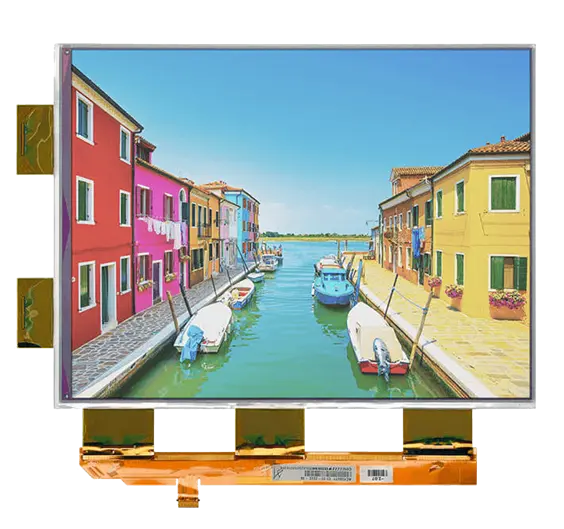
ACeP, used in products such as the E Ink Gallery series, also relies on multiple types of pigment particles. However, it uses a different combination of pigments and a different approach to color mixing than Spectra. The technology employs four pigments – cyan, magenta, yellow and white. By precisely controlling the position of these particles, ACeP can produce a wide range of colors within each pixel, without requiring RGB color filters. This enables the reproduction of more complex images, including illustrations, photographs and graphics with subtle tonal transitions.
Color e-paper technologies differ in several aspects, including the range and saturation of reproducible colors, resolution and refresh time. Choosing the right solution therefore depends on the type of content to be displayed and the specific requirements of the application.
Advantages and disadvantages of e-paper
Like TFT LCDs and OLEDs, EPD technology has its advantages and limitations. Their significance depends primarily on how the display is used and the conditions in which it operates.
Advantages of e-paper
- Very low power consumption – thanks to bistability, the image remains visible without continuously powering the display panel. This helps reduce energy consumption, particularly in devices where information is updated infrequently.
- Wide viewing angles – displayed information remains readable from different angles, which is particularly important in public information systems.
- Excellent readability in daylight – the reflective nature of e-paper ensures good visibility even in direct sunlight, without the need for backlighting. The absence of a backlight also makes it possible to design thinner devices.
- Battery-powered operation – low energy requirements make e-paper particularly suitable for portable, wireless and autonomous devices that need to operate for extended periods without battery replacement or recharging.
- Well suited to static content – EPD technology is particularly effective for displaying text, labels, diagrams and graphics that need to remain visible on the screen for extended periods.
Disadvantages of e-paper
- Longer refresh times – updating content takes longer than with TFT LCDs or OLEDs, limiting the use of e-paper in devices that require frequent image updates or dynamic content.
- Potential ghosting – traces of previously displayed content may remain visible after an image update. Minimizing this effect requires appropriate controller selection and configuration, as well as suitable refresh modes.
- Dependence on ambient light – in darkness, e-paper requires an additional light source, such as a frontlight system, to make the displayed content visible.
- Temperature limitations – extremely low or high ambient temperatures can affect e-paper performance, including image refresh times.
- Susceptibility to mechanical damage – modules built on glass substrates are sensitive to pressure, bending and mechanical stress, making proper protection essential during installation and operation.
- Limited color reproduction – despite advances in color e-paper technology, some variants still offer a narrower color gamut and lower color saturation than TFT LCDs or OLEDs.
Applications of e-paper
The unique characteristics of EPD technology make it particularly suitable for applications where readability, energy efficiency and the ability to display static content for extended periods are more important than frequent image updates.
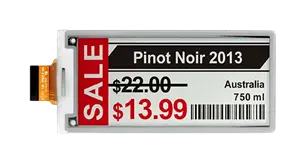
One of the most common applications of e-paper is retail. Electronic shelf labels (ESLs) enable centralized management of product information, eliminating the need to manually replace traditional price tags. Larger EPDs are also used to display promotions, announcements and advertising content.
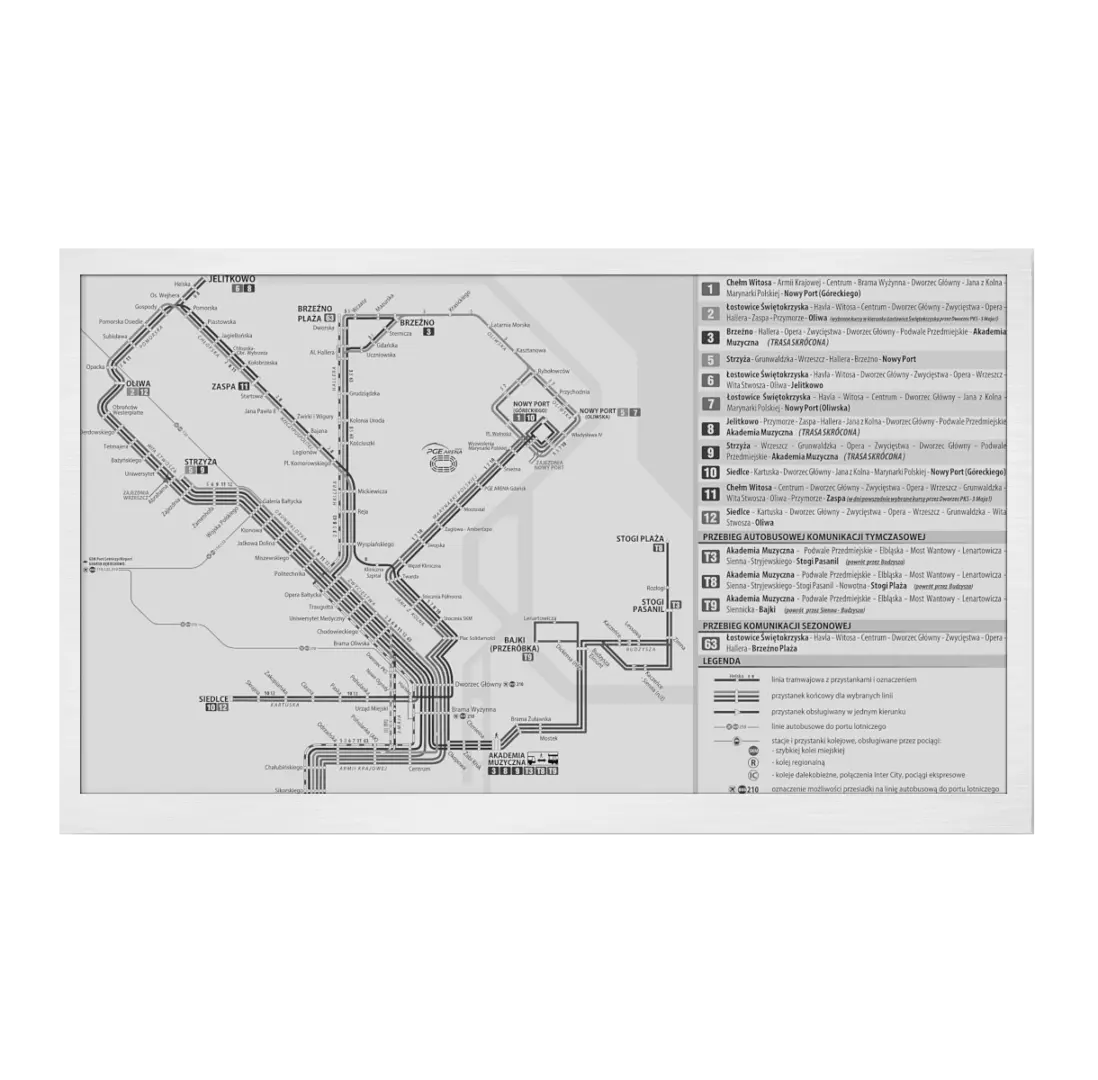
In public transportation, e-paper is used in electronic timetables, bus stop displays and passenger information systems. Its key advantages include excellent daylight readability and low energy consumption, which is particularly beneficial for autonomous installations.
Another important area is industrial applications and IoT, including measuring instruments, monitoring systems, identification tags, workstation signage and logistics labels. EPDs can present measurement results, device status and operational information without requiring continuous power to maintain the displayed image.
E-paper is also used in smart buildings, offices, healthcare facilities and public institutions, for applications such as electronic room signage, information boards and meeting room booking systems.
E Ink Kaleido – Color E-paper for More Detailed Content
In applications where monochrome text and graphics are not sufficient, displays based on E Ink Kaleido technology are worth considering. This technology combines a monochrome electrophoretic layer with an RGB color filter, enabling the presentation of multicolor graphics while retaining key characteristics of e-paper, including low power consumption when displaying static content.
For example, E Ink Kaleido 3 supports 4,096 colors, with selected modules offering a resolution of 300 PPI for monochrome content and 150 PPI for color images. This technology is used in devices such as e-readers, where color helps distinguish specific elements of the displayed content. It is particularly useful for presenting charts, maps, diagrams and other information where color improves visual clarity.
However, the additional color filter affects the display’s optical properties. Compared with monochrome EPDs, color images may have lower reflectance, reduced effective resolution and less saturated colors.
Sharp’s A2-format Color E-paper
Advances in EPD technology have also enabled the development of larger displays that can replace traditional printed information materials. One example is Sharp’s LP285A6NW01, a 28.5-inch e-paper display corresponding to A2 paper format. The panel offers a resolution of 2160 × 3060 pixels and uses E Ink Spectra 6 technology to display multicolor content. Thanks to its large active area and reflective properties, this display is well suited for information and advertising systems, including digital posters.
For more details on its specifications and potential applications, read our article Color E-paper in A2 Format: A New Solution from Sharp.

Challenges of Integrating EPD Technology
Integrating EPD technology into an end device involves a number of technical and business challenges. Addressing them early in the design process helps minimize the risk of problems during integration and subsequent operation.
Operating Temperature
One of the key limitations of EPD technology is its sensitivity to temperature. Many standard modules operate within a temperature range of 0°C to +50°C. However, displays designed for wider temperature ranges are also available, with operating limits extending from −15°C to +65°C or −20°C to +65°C, depending on the display type. For example, selected 31.2-inch EPD modules can operate at temperatures ranging from −15°C to +65°C. It is important to note, however, that the permissible operating temperature range and supported refresh modes vary by model and must be verified against its technical documentation.
Low temperatures can slow down the movement of pigment particles, resulting in longer refresh times or limiting the availability of certain operating modes. High temperatures, on the other hand, can negatively affect image quality, while exceeding the specified operating limits may even cause permanent damage to the display.
For outdoor applications, additional thermal management solutions may be required to keep the display within its permitted operating temperature range. In cold conditions, these may include temperature-controlled heaters and appropriate thermal insulation. Preventing excessive heat buildup, particularly under direct sunlight, may require heat sinks, fans for forced-air circulation or other cooling solutions. However, these additional components increase design complexity and may also affect power consumption and the overall cost of the device.
Additional Lighting
EPDs rely on ambient light, so their readability depends on the surrounding lighting conditions. While displayed content remains clearly visible in bright daylight, an additional light source may be required in darkness or poorly lit environments. This is particularly important for devices designed for continuous operation, such as passenger information systems.
One solution is a frontlight system, which, unlike the backlighting used in TFT LCDs, illuminates the display from the viewer’s side. It typically consists of LEDs positioned along the edges of the display and a specially designed light guide layer that distributes light across its surface. This allows the content to remain readable in darkness while preserving the reflective nature of EPD technology.
An alternative is to use external lighting, such as LED fixtures installed above or near the display. In this case, careful positioning of the light sources is essential to ensure uniform illumination, minimize shadows and prevent reflections that could interfere with readability.
The choice of lighting solution should take into account the device’s operating environment, readability requirements and mechanical integration constraints. A frontlight system may increase the display assembly’s thickness and design complexity, while external lighting requires additional components to be positioned around the device. Both approaches also increase power consumption, which is particularly important for battery-powered or autonomous applications.
Mechanical Durability
Another challenge is the susceptibility of EPDs to mechanical damage. Many modules use thin glass substrates that can be damaged by pressure, bending, impacts or stress during assembly. This is particularly important for larger displays, whose combination of a large surface area and minimal thickness makes safe integration more challenging. Displays with flexible substrates are also available, although they still require appropriate protection.
Proper mechanical design plays a key role in protecting the display from damage and ensuring secure mounting within the device. Depending on the application, suitable solutions may include additional protective glass, a purpose-designed mounting frame, flexible spacers or components that absorb shocks and vibrations. The design should also account for how the module is supported, the positioning of mounting points and the dimensional tolerances of individual components. These factors help minimize mechanical stress on the display during both assembly and subsequent operation.
Another option is optical bonding, which involves joining the display surface to protective glass using a transparent optical adhesive. When properly designed, this integration increases the rigidity of the entire module and helps reduce the risk of mechanical damage. Eliminating the air gap between layers also reduces internal reflections and minimizes the risk of moisture and contaminants accumulating in this space.
The choice of protective measures should reflect the device’s operating conditions, including potential exposure to shocks, vibrations, pressure on the screen surface and accidental impacts. For devices installed in public spaces in particular, a well-designed mechanical structure is essential to the durability and long-term reliability of the complete solution.
Display Control and Image Refresh
Controlling an EPD is more complex than managing many other display technologies. This is due to the way images are formed, which requires precise control over the movement of pigment particles. The process relies on carefully defined voltage pulse sequences (waveforms), whose timing and characteristics depend on factors such as the display type, operating temperature and image update method.
Choosing the right EPD controller is essential for managing the image refresh process. Depending on the panel, the controller may support different refresh modes, including full-screen refresh (full refresh), updates to selected areas (partial refresh) and accelerated image updates (fast refresh). These modes differ in refresh time, resulting image quality and how the updates are performed.
The main challenge is balancing refresh speed with image quality. Frequent use of fast or partial refresh modes can lead to ghosting, where traces of previously displayed content remain visible on the screen. This effect can be minimized through appropriate controller configuration and periodic full-screen refreshes. Although full refreshes help restore image quality, they take longer and may cause noticeable screen flashing.
Integrating an EPD therefore requires more than selecting a compatible controller. It also involves properly designing the electronics and developing the control software. Key considerations include using waveforms suited to the specific panel, selecting supported refresh modes and determining how frequently the displayed content should be updated. The impact of temperature on the refresh process must also be taken into account. Proper configuration and testing help minimize ghosting and ensure that the display operates as required by the application.
MOQ and Project Feasibility
Integrating an EPD into a device also involves business challenges, particularly those related to component availability, development costs and production planning. With e-paper technology, minimum order quantities can be a significant barrier, especially for smaller-scale projects.
Display manufacturers typically specify an MOQ (Minimum Order Quantity) – the minimum number of units that must be ordered for a particular project or production batch. These requirements reflect the economics of manufacturing, including production line setup costs, material and component procurement, and production planning. MOQ requirements for EPDs can be more restrictive than those for many TFT LCD modules, although the actual quantities depend on the manufacturer, specific model and scope of customization.
Projects requiring custom EPDs, such as displays with specific dimensions, shapes or technical parameters, can be particularly challenging. Developing such solutions may involve dedicated production tooling, additional engineering work and testing. These activities generate one-time costs, known as NRE (Non-Recurring Engineering), which must be factored into the project budget. With smaller production volumes, spreading these costs across a limited number of devices can significantly increase the unit cost, potentially making the project economically unviable for both the display manufacturer and the customer.
Long-term component availability is another important consideration. Industrial devices are often manufactured and operated for many years, making it essential to verify the long-term supply prospects of the selected EPD model early in the design process. Lead times, planned production volumes and the risk of component discontinuation should also be considered. For custom-developed displays, changing suppliers or replacing a panel with an alternative model may require additional engineering work and revalidation of the solution.
Assessing project feasibility therefore requires looking beyond the price of an individual display to consider the costs of integration, prototyping, testing and subsequent mass production. Evaluating these factors early in the development process helps identify a solution that meets the application’s technical requirements while remaining economically viable at the planned production scale.
Unisystem’s Solution Department – Engineering Support for E-paper Projects
At Unisystem, we continuously develop our engineering capabilities to go beyond the role of a distributor of off-the-shelf components. Our Solution Department brings together a multidisciplinary team of electronics and mechanical engineers, software developers and project managers who collaborate to create solutions tailored to individual customer requirements.
When working with EPD technology, combining expertise from different engineering disciplines is particularly important. Selecting the right display is only one part of developing a complete solution. Equally important are the compatibility of the control electronics, mechanical design, software and adaptation of the device to its intended operating environment.
Our collaboration with customers begins with a detailed analysis of the application and its requirements. We identify what information needs to be displayed, how frequently it will be updated, the environment in which the device will operate, and any technical or business constraints that must be considered. Based on this analysis, we develop a solution concept and define the scope of the engineering work. Depending on the project’s requirements, this may include selecting the EPD module and controller, designing electronics and PCBs, developing mechanical components, integrating additional hardware, and preparing firmware and software. The next stages involve prototyping, testing and validation. We verify not only the display’s functionality but also its compatibility with other system components and its performance under conditions representative of the intended operating environment. Once these stages are complete, we prepare the solution for implementation and mass production.
This approach allows us to take on projects where a standard display module alone cannot meet all the requirements. Rather than limiting ourselves to the specifications of an available panel, we explore how it can be integrated and how the complete solution can be adapted to the customer’s application.
For more information about our team’s expertise and project development process, read our interview with Jacek Marcinkowski, CTO at Unisystem: “Solution” in Practice – How Unisystem Responds to Real Customer Challenges. We also explain the individual stages of engineering development in our article Designing Electronics and Mechanics in Display-Based Devices – Step by Step.
USEC and USEM – Unisystem’s Proprietary E-paper Solutions
Our USEC and USEM modules are examples of how we apply our engineering expertise in practice. Developed by Unisystem using E Ink’s EPDs, these solutions are designed to simplify the integration of e-paper into end devices by combining the display with additional electronic and mechanical components.
Importantly, USEC and USEM are not off-the-shelf products available directly from stock. They are developed on a project basis, with their configuration and scope of integration tailored to the specific requirements of each application.
USEC – EPDs with Integrated Controllers
USEC combines an e-paper display with a dedicated controller.
The controller manages the image update process, including both full-screen refreshes and updates to selected areas of the screen. Properly configured refresh modes also help minimize ghosting and adjust refresh speed to the application’s requirements.
Integrating the display with a controller reduces the amount of engineering work customers need to undertake when developing their own control electronics. This is particularly valuable in projects where engineering resources need to focus on the functionality of the complete device rather than developing EPD control circuitry from scratch.
USEM – EPDs with Integrated Controllers in an Open-frame Design
USEM builds on the USEC concept by incorporating additional mechanical components.
USEM modules combine an e-paper display and controller within an open-frame structure that provides mechanical support and simplifies installation into the end device.
Our designs also incorporate two layers of protective glass, bonded to the display using optical bonding. This approach improves the mechanical durability of the complete module and helps protect the display’s delicate structure from damage.
Additional protection is provided by a UV filter embedded in the interlayer between the two protective glass sheets. It reduces the amount of ultraviolet radiation reaching the display, helping minimize the risk of image fading. This is particularly important for outdoor applications, where displays may be exposed to sunlight for extended periods.
USEC and USEM reflect our experience in developing advanced EPD-based solutions tailored to specific application requirements. We define the scope of integration individually for each project, taking into account technical specifications, planned production volumes and economic feasibility.
For more information about the design and construction of both solutions, read our article USEC and USEM by Unisystem – The New Version of E-paper Solutions Based on E Ink’s Products.
Considering EPD technology for your next project? Contact our team to discuss your requirements and explore solutions tailored to your application.