Article summary generated by AI — it may contain errors.
Table of contents
Modern screens have become the communication centre of devices – they are used not only to present information, but also to operate the device directly. For the image to be legible and interaction precise and comfortable, several key components – the display, the touch sensor and the protective glass – must be combined into one coherent module. It is the way they are bonded together that largely determines the quality, durability and reliability of the entire solution. In this article, we discuss two variants for bonding layers: with an air gap (air bonding) and the optical variant (optical bonding).
Two technologies are most commonly used to join layers: air bonding, which involves bonding along the entire frame of the display while leaving a thin air gap between the individual components, and optical bonding, which fills this space with a transparent optical adhesive that bonds the layers over the entire surface and creates a uniform, void‑free structure. Although the difference between these solutions may seem minor at first glance, in practice it determines the functionality and reliability of the entire device.
Optical bonding
Optical bonding – what is it?
Optical bonding is a process of permanently bonding the display, touch sensor and protective glass across the full surface using specialist, optically transparent adhesive materials. The aim of the process is to eliminate the air gap between the layers and obtain a homogeneous structure with high transparency, mechanical stability and predictable optical properties. The adhesives used are characterised by high light transmission, chemical stability and a refractive index matched to the other elements of the module.
The bonding process itself is carried out in several strictly controlled stages. First, the components are precisely positioned and aligned to ensure correct operation of the display and touch sensor across the entire working area. The actual lamination or curing stage follows, depending on the type of material used – using pressure, elevated temperature, vacuum or UV radiation. A key element of the process is the complete removal of air bubbles and ensuring homogeneous contact between the layers.
The result of optical bonding is a monolithic module in which the display, touch sensor and protective glass function as a single element. In industrial and professional applications such bonding is considered permanent and non‑serviceable because it provides the highest optical quality, environmental resistance and long‑term reliability of the whole system.
Materials used in optical bonding
Several groups of materials are available on the market for use in optical bonding. They can be divided into two basic types: solid materials, which come in the form of sheets or preforms with a controlled thickness (OCA, SOCA and SCA), and liquid materials, which are applied directly over the entire surface of one of the components in the form of adhesives (LOCA). All of these materials are designed for permanently bonding displays, touch sensors and protective glass, but they differ in chemical composition, application method and properties.
OCA (Optical Clear Adhesive)
OCA (Optical Clear Adhesive) is a solid, optically transparent adhesive that comes in the form of thin films of precisely controlled thickness. Application of OCA involves placing the film between the layers of the module and then carrying out a lamination process using controlled pressure and elevated temperature, often under vacuum conditions or in an autoclave. This process makes it possible to achieve homogeneous contact over the entire surface and high optical quality. OCA is characterised by very good transparency, stability of parameters over time and high repeatability of the process, which is why it is commonly used in series production of display modules.
SOCA (Silicone Optically Clear Adhesive)
SOCA (Silicone Optically Clear Adhesive) is a transparent silicone adhesive which, depending on the formulation, is available in the form of sheets or gel and is applied between the layers of the module. The bonding process using SOCA is based on the precise positioning of the components and controlled pressure, followed by activation of the bonding process through elevated temperature or a chemical reaction taking place over time. This material is characterised by elasticity and stable mechanical properties. A key feature of SOCA is the possibility of controlled separation of the layers after curing, using appropriate servicing procedures and tools, without significantly deteriorating the optical parameters of the components. Because of its high price, SOCA is classified as a premium solution and is used in modules designed for long‑term operation.
SCA (Solid Clear Adhesive)
SCA (Solid Clear Adhesive) is a solid, transparent adhesive that comes in the form of sheets or preforms of precisely controlled thickness. Application of SCA involves placing the material between the layers to be joined and then bonding the components using controlled pressure and elevated temperature. This process provides high optical homogeneity, stable parameters and a low risk of air bubbles, making SCA a solution well suited to series production and applications that require high repeatability of quality.
LOCA (Liquid Optically Clear Adhesive)
LOCA (Liquid Optically Clear Adhesive), sometimes also referred to as OCR (Optical Clear Resin), is a liquid acrylic adhesive which, after application to the surface of a component, cures under UV radiation to form a rigid, durable and optically clear layer. Older LOCA formulations could show a tendency to yellow under UV radiation and elevated temperature, whereas modern materials are designed to limit this phenomenon. The bonding process using LOCA is more complex and generally more expensive than bonding with solid materials – it requires precise dispensing, vacuum control and thorough UV curing. The presence of air bubbles often means that the entire module has to be replaced.
Advantages and disadvantages of optical bonding
Optical bonding offers a number of benefits resulting from completely filling the space between the layers with a transparent optical adhesive. The uniform, compact structure provides, above all, excellent optical properties – it reduces light reflections, increases image contrast and improves its readability in a variety of lighting conditions.
An important advantage of optical bonding is the high mechanical durability of the module. Because the adhesive bonds the layers over the entire surface, the forces acting on the screen surface are distributed evenly, which to some extent protects the structure against shocks, vibrations and impacts and facilitates compliance with the IK standard. It is worth emphasising, however, that the use of optical adhesive alone does not guarantee achievement of a specific IK level. This also requires a suitably selected thickness and type of glass and a properly designed mechanical structure of the enclosure. Optical bonding makes it easier to meet the requirements of a given IK class but does not constitute an independent certifying factor.
Another advantage is increased tightness of the module, resulting from completely filling the space between the layers with adhesive. This solution effectively limits the penetration of dust, particulate matter, and moisture into the inside of the module and prevents it from fogging up during rapid temperature changes, which is particularly important, e.g. in outdoor applications.
In addition, the smaller distance between the touch sensor and the protective glass improves the responsiveness and precision of the touch function.
All of this translates into high user comfort, enhancing the overall user experience (UX).
At the same time, optical bonding also has certain limitations. The bonding process is complex and requires specialist equipment and controlled production conditions, which contribute to higher manufacturing costs. Any defects, such as air bubbles, discolouration, or uneven adhesive distribution, are difficult to remove at a later stage, and repairing optically bonded modules is often not possible without replacing the entire set of components. Some adhesives may also be sensitive to extreme temperatures or long‑term exposure to UV radiation, requiring careful selection of technological parameters based on the device’s application. For this reason, it is advisable to use the services of a trusted partner with appropriate experience and technological capabilities to ensure high-quality workmanship.
Applications of optical bonding
Optical bonding is a technology particularly often used in industrial applications and above all in devices that are expected to provide excellent readability, reliability and durability in demanding environmental conditions. It works well in a wide range of equipment, including:
- HMI interfaces, including operator panels in production plants,
- medical and laboratory equipment, requiring precise and unambiguous data reading,
- control panels in public transport vehicles – buses, trams, trains,
- control panels in special‑purpose vehicles (e.g. for military, construction or agricultural applications),
- digital signage systems, including passenger information systems at stations, stops, terminals and airports,
- mobile devices, including measuring devices used in industry,
- information kiosks,
- self‑service terminals,
- vending machines.
In many cases, the optical bonding technology genuinely makes this type of equipment easier to use, improving the comfort of work for users. It is worth adding that it is often not only the preferred but also the recommended choice when designing devices intended for outdoor operation.
Air bonding
Air bonding – what is it?
Air bonding is a component assembly technology in which the display, touch sensor and protective glass are mechanically positioned and fixed, most often using a double‑sided adhesive layer applied on the edges, which stabilises the structure and prevents it from moving. The resulting layout does not create a single compact structure – the layers function as separate elements separated by an air gap.
Advantages and disadvantages of air bonding
Air bonding has several practical advantages arising mainly from the simplicity of the technology. The most important advantage is lower production cost – the process does not require specialist materials or advanced production equipment, nor does it operate under vacuum conditions. An additional advantage is easier servicing of the module, because the layers are not bonded over the entire surface, repairing or replacing the display, touch sensor or protective glass is simpler and cheaper.
The limitations of air bonding result directly from leaving an air gap between the layers. The presence of this space increases the amount of light reflections, which can reduce contrast and image readability, especially under intense lighting. In addition, the presence of an unfilled space increases the risk of condensation of water vapour, which under certain environmental conditions can lead to fogging of the internal surfaces of the screen. The unfilled space also reduces mechanical resistance – forces acting on the glass do not distribute evenly, making the module more susceptible to damage under shocks or impacts.
Applications of air bonding
Air bonding is chosen in the design of devices in which low production costs, ease of servicing and lack of particular requirements for image readability or module tightness are key. This technology finds application in, among others:
- HMI interfaces, including control panels operated in stable lighting conditions and a favourable environment (low dust and contamination, stable humidity, no abrupt temperature changes),
- consumer electronics, including basic tablets and monitors,
- smart home solutions, such as thermostats,
- information kiosks, self‑service terminals and vending machines designed for installation in indoor environments with stable environmental conditions,
- devices in which regular replacement of components exposed to damage has been foreseen – e.g. the protective glass.
Air bonding is therefore often the optimal choice for projects in which the priorities are cost, simplicity of construction and serviceability of the device. It is usually used in devices intended to operate indoors, although this is not a rule.
Air bonding vs. optical bonding
The choice of the method used to join the components forming a display module – air bonding or optical bonding – has a significant impact on its functional parameters, durability, and operational capabilities. The two technologies differ in terms of optical, structural, and environmental properties; therefore, the decision to use one of them should be based on an analysis of application requirements, device operating conditions, and end-user expectations. Review the comparison below to determine which method – air bonding or optical bonding – is suitable for the solution you are designing.
Image quality
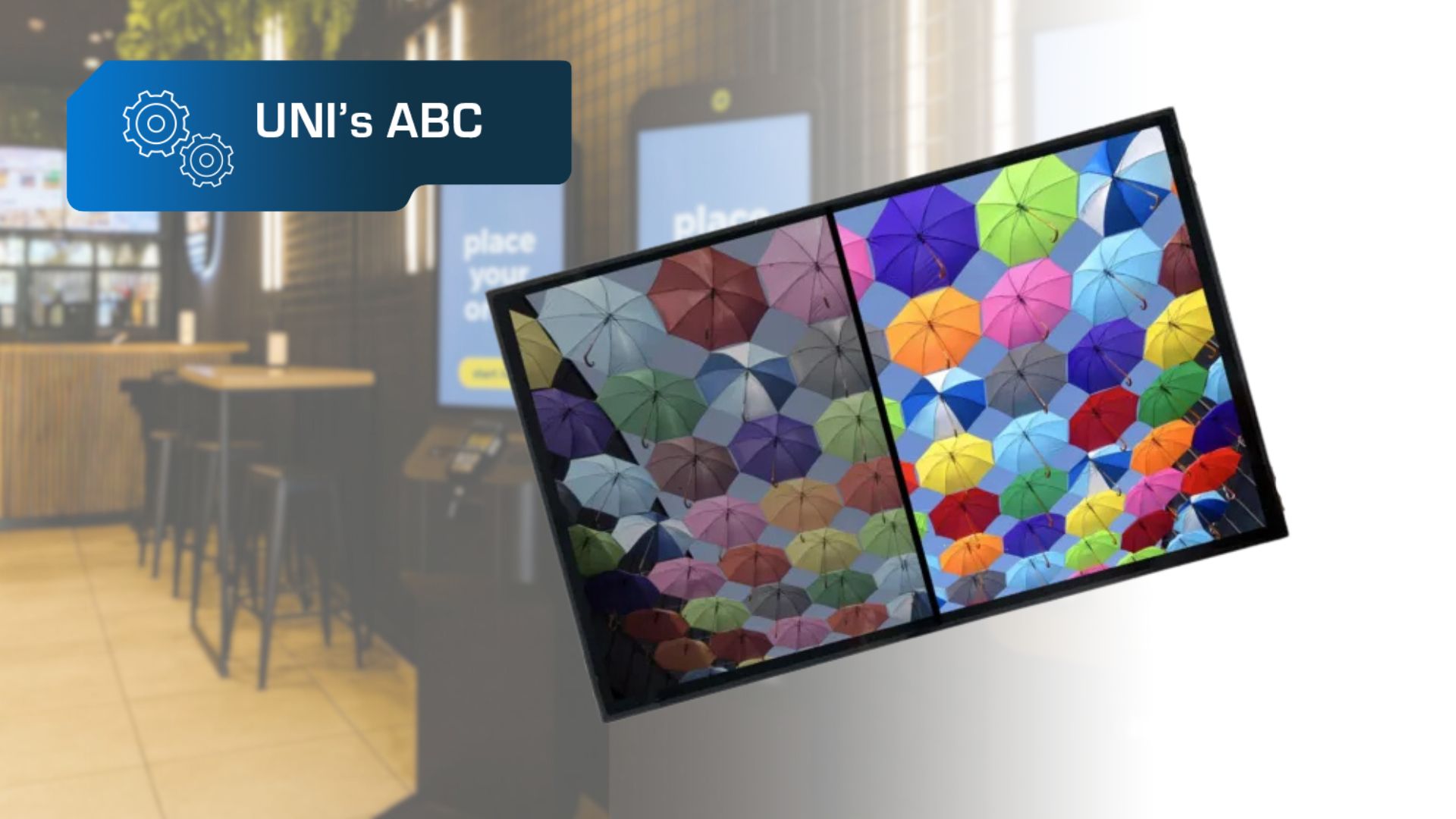
One of the key advantages of optical bonding over air bonding is image quality. Filling the space between layers with a material whose refractive index is close to that of glass eliminates light reflections and improves light transmission. As a result, the user perceives an image with higher contrast, more vivid colours, and deeper blacks.
The difference is particularly noticeable in devices operating under strong lighting conditions, especially in sunlit environments. In such cases – provided that the display panel itself is designed for operation in high ambient light – modules manufactured using optical bonding achieve even better readability and glare reduction. However, reflections are not eliminated entirely, as reflections from the outer surface of the protective glass always remain. These effects cannot be achieved with air bonding technology, which in practice excludes its use in many outdoor applications.

Durability and environmental resistance
Optical bonding significantly increases the durability of the display structure. The absence of an empty space between the layers prevents moisture and contaminants such as dust or particulates from penetrating the interior of the module. In designs using air bonding, the presence of such a gap may lead to water vapour condensation, reduced transparency, and gradual optical degradation.
In optical bonding technology, the optical adhesive layer eliminates the empty space between the layers, creating a continuous module structure. As a result, mechanical loads are distributed more evenly across the entire surface of the display, which increases structural stability and reduces the risk of damage caused by vibrations, shocks, or point loads. For this reason, optical bonding is often selected for devices intended to operate in demanding environmental conditions and in applications involving long-term and intensive use, where enhanced reliability parameters are of critical importance.

Module thickness and structural properties
Optical bonding makes it possible to reduce the overall thickness of the module by eliminating the need for double-sided adhesive tape (DST) between the display and the protective glass. Thanks to full-surface bonding of the layers and the elimination of the air gap, a compact, monolithic structure is achieved, characterised by higher rigidity and improved mechanical integrity.
In the case of air bonding, the layers are joined in a way that leaves an air gap between the display and the protective glass. Such a design exhibits lower overall stiffness, which may affect its mechanical resistance and behaviour under vibration or compressive loads.

Cost
Technological differences between the two methods translate directly into production costs.
Air bonding, due to its simple assembly process and shorter production time, is a more cost-effective solution and is often used in devices with limited budgets that operate in stable environmental conditions.
Optical bonding involves higher manufacturing costs; however, it represents an investment in device quality and durability. A stable structure, higher environmental resistance, and a lower risk of failure mean that the total cost of ownership may be lower over a long period of use. For this reason, optical bonding is selected for systems that must operate reliably for many years.
Servicing
In air bonding, the layers of the module are not permanently bonded, which facilitates the replacement of components such as the touch sensor or protective glass. The structure can be disassembled, and repairs can be carried out without interfering with the entire display assembly.
In optical bonding, the display, touch sensor, and protective glass are permanently integrated. Depending on the adhesive material used (e.g. OCA, SCA, or LOCA), the module will be non-separable, which limits repair options. An exception is technologies using SOCA adhesives, which allow the layers to be separated after curing; however, this solution is more expensive.
Touch panel sensitivity
Eliminating the air gap in modules manufactured using optical bonding improves touch panel precision by reducing the parallax effect. Parallax is a phenomenon in which the image displayed appears shifted relative to its actual position, noticeable when the screen is viewed at an angle.
In air-bonded designs with an air gap, the physical point of contact on the glass surface may not coincide with the location where the user sees an interface element on the screen, giving the impression of inaccurate touch response. This effect is particularly noticeable with thicker protective glass.
Optical bonding eliminates this discrepancy by combining the protective glass and the display into a single optically coherent structure. As a result, the touch point is perceived as precisely aligned with the displayed content, leading to a more intuitive, stable, and predictable touch panel response.

The table below presents the key differences between optical bonding and air bonding technologies:
| Feature | Optical bonding | Air bonding |
| Bonding structure | Full filling with optical adhesive | Air gap between layers |
| Image quality | High contrast, reduced light reflections | Lower contrast, presence of light reflections |
| Readability in high ambient light | Higher | Lower |
| Mechanical resistance | Higher | Lower |
| Sealing (resistance to dust, particulates, and moisture ingress) | Higher | Lower |
| Resistance to temperature changes | Higher | Lower |
| Production cost | Higher | Lower |
| Servicing | More difficult, if possible at all | Easier |
The choice of method for joining the components that make up the display module is influenced by a number of factors, among which the key can be considered the working environment and user requirements, as well as budget constraints.
Optical bonding offers better optical properties, higher resistance to external factors and greater mechanical durability, which is why it is recommended for applications in which readability of the content displayed, reliability and operation in demanding environmental conditions are of key importance. Air bonding remains, however, an attractive alternative in projects with a limited budget that do not require the highest image quality and are intended for use in a stable environment.
The final choice of technology is worth making at the design stage of the device – preferably in cooperation with an experienced component supplier. Specialists from Unisystem, as experts with many years of experience in implementing projects using both optical bonding and air bonding, can select an optimal solution for a specific application, working environment and budget.
Frequently asked questions: optical bonding and air bonding in project practice
Below we have collected answers to the most frequently asked questions about optical bonding and air bonding. If your question is not listed here, our specialists will be happy to answer it directly – please contact us.
When should optical bonding be used?
Optical bonding is worth using wherever high image readability, resistance to environmental conditions and long device lifetime are key. It is particularly suitable for devices operating outdoors or in brightly lit rooms, in applications exposed to shocks, vibrations and impacts, as well as in specialist equipment such as medical or laboratory devices where unambiguous data reading is necessary. It is also a good choice for systems in which servicing should be as infrequent as possible and every downtime is associated with tangible costs.
When should air bonding be used?
Air bonding is a good solution in projects where the priority is low production cost and simplicity of design. It works well in devices operating in a stable indoor environment, with controlled lighting and low levels of contamination, and where the highest image readability is not required under intense light. It is also a beneficial option in applications in which easy and inexpensive replacement of components, such as the protective glass, is important.
Which bonding technology should be chosen for applications intended for outdoor use?
For outdoor applications, optical bonding is usually recommended because:
- it significantly reduces light reflections and improves readability in sunlight,
- it increases the tightness of the assembly between the LCD display and the PCAP touch panel (or protective glass), limiting the risk of dust, particulate matter and moisture entering the optical space of the module,
- it increases the module’s resistance to mechanical damage.
Air bonding in outdoor environments can only be considered in specific, less demanding cases (e.g. in sheltered locations).
Does optical bonding improve resistance to mechanical damage?
Yes. Full‑surface bonding ensures that the display, touch sensor and protective glass form a single rigid module. Loads are distributed evenly across the entire surface, which improves resistance to impacts and shocks and reduces the risk of screen damage under local pressure, provided the device’s mechanical design is correct.
Does optical bonding affect the operation of the touch panel?
Yes, usually positively. Reducing the distance between the touch sensor and the protective glass improves reading precision.
Does optical bonding increase the thickness of the module?
No. In most cases, optical bonding actually allows the module thickness to be reduced. Eliminating the air gap and the possibility of using a thinner protective glass while maintaining the required mechanical strength means that the entire structure can be slimmer, stiffer and less susceptible to deformation than in the variant with air bonding.
Is optical bonding always more expensive than air bonding?
At the production stage, optical bonding is usually more expensive than air bonding because it requires the use of specialist materials, precise processes and stringent quality control. It is worth emphasising, however, that although optical bonding increases production costs, over the life cycle of the device it often reduces operating costs thanks to fewer failures, greater environmental resistance and longer module life.
Can optical bonding be applied to every display?
Optical bonding is not a universal solution for all types of displays. Its applicability is determined, among other things, by the frame design, the layout of the active area, permissible mechanical stresses, the required operating temperature range, the level of exposure to UV radiation and the compatibility of the adhesive with the panel materials.
For this reason, the possibility of carrying out optical bonding is best assessed already at the device design stage, together with a supplier who will verify whether a given component meets all technological requirements.
Does optical bonding always mean that the module cannot be serviced?
Not always, but in most industrial applications, modules with optical bonding are regarded as non‑serviceable. With adhesives such as OCA, SCA or LOCA, repair usually involves replacing the entire set: display, touch sensor and protective glass. SOCA technology makes it possible to separate the layers after curing, but this requires an appropriate process, tools and experience, so it is used mainly in premium applications where this possibility has been envisaged at the design stage.
Does optical bonding improve readability in full sunlight (sunlight readability)?
Yes. Optical bonding improves image readability in full sunlight. Filling the space between layers with optical adhesive reduces light reflections in the air gap of traditional constructions. As a result, light passes through the module directly, and the user sees an image with fewer reflections, higher contrast, more intense colours and deeper blacks.
In practice, this means that the display remains readable even under very strong lighting – provided that the matrix itself has sufficiently high brightness. Optical bonding does not completely eliminate external reflections, but it significantly reduces them, which in outdoor devices makes a noticeable difference in user comfort.
Can optical bonding be combined with additional coatings (AR, AG, AF)?
Yes. Optical bonding is compatible with anti‑reflective (AR), anti‑glare (AG) and hydrophobic/oleophobic (AF) coatings, which further improve user comfort.
Does optical bonding extend the production time of the module?
Yes. Optical bonding is a more complex process than air bonding – it requires precise layer alignment, vacuum lamination, adhesive curing, and thorough quality control. Each of these stages extends the production cycle, so this technology is chosen when the priority is high module quality and durability rather than the fastest assembly.
Can optical bonding only be carried out in a factory?
Yes. Optical bonding is a process that requires specialist equipment – including vacuum chambers, precise positioning systems and adhesive curing technology – so it is carried out exclusively under factory conditions. Only there can appropriate cleanliness, temperature control and elimination of air bubbles be ensured.
Can optical adhesive degrade over time?
Yes. Optical adhesives, especially older or lower‑quality acrylic formulations, can degrade over time – most often in the form of yellowing, loss of transparency or mechanical changes under the influence of UV radiation, temperature or humidity. Modern materials are, however, designed to minimise these phenomena and provide long‑term optical and chemical stability of the module.
Can optical adhesive yellow over time?
Yes. Optical adhesives, especially older or simple acrylic formulations used in technologies such as classic LOCA, can yellow over time under the influence of UV radiation, high temperature or prolonged exposure to light. This phenomenon affects the transparency of the module and can reduce image quality. In modern solutions, however, advanced materials are used that have been developed to minimise the risk of yellowing and maintain optical stability for many years of use.
Is optical bonding compatible with high‑brightness panels?
Yes. Optical bonding is fully compatible with high‑brightness panels and is often used precisely in such constructions. High panel brightness improves image readability under intense light, and optical bonding further enhances this effect by reducing light reflections, improving contrast and increasing the efficiency of the emitted light.
How does the impact resistance differ between air bonding and optical bonding?
Optical bonding provides higher impact resistance because the optical adhesive bonds all the layers over the entire surface, creating a rigid and stable structure. Thanks to this, the forces acting on the screen are distributed evenly, which significantly reduces the risk of cracks or local damage.
In air bonding, the layers are separated by an air gap, so impacts are transmitted primarily to protective glass. The lack of full‑surface support makes the module more susceptible to cracking, deformation and damage, especially under point loads.