Article summary generated by AI — it may contain errors.
Table of contents
For more than three decades, Unisystem has been active in information visualization technologies, supporting manufacturers of electronic devices in the selection, integration, and development of components tailored to specific application requirements. Over the years, our role has gradually evolved – from a component supplier, through a technology partner, to a designer and manufacturer of our own LCD-TFT displays.
Unisystem’s new product lines are a natural outcome of this development path and a response to the needs of dvice manufacturers looking for proven, easy-to-integrate solutions tailored to specific applications. They have been created based on many years of work with customers on customized projects, where standard products available on the market often required modification, adaptation, or further development. In practice, this meant taking a wide range of factors into account – the device’s operating environment, mounting method, expected readability, mechanical robustness, touch panel performance, electronics requirements, and enclosure-related design constraints.
Each of these projects gave us valuable insight into what device manufacturers actually need. Across many applications, similar challenges kept recurring: easier integration, stable parameters, predictable product lifecycle, improved resistance to operating conditions, and the ability to further adapt the module to a specific mechanical design. This experience has led to the creation of three product lines: Unisystem Lite, Unisystem Core, and Unisystem Pro.
The new modules will be available in popular sizes of 7”, 10.1”, 12.1”, and 15.6”, making it easy to match them with different device formats. Each size will also be available with a capacitive touch panel (CTP), allowing the module to be used in devices that require direct screen operation. In touch versions, optical bonding will be provided as standard to improve image readability, reduce light reflections, and strengthen the module structure. Depending on the variant, popular display interfaces such as RGB, LVDS, and MIPI will be available, making integration with different hardware platforms and device architectures easier.
Another important feature of the new products is their declared 10-year availability – particularly important in industrial projects, where supply stability and long-term deployment security are key.
Unisystem Lite – everything an indoor application needs
Unisystem Lite is a line of LCD-TFT displays designed for devices operating in stable indoor conditions. It is intended for projects where clear information presentation, easy integration, and a balanced set of parameters matched to the application’s actual needs are key. Lite is well-suited to environments where the highest level of environmental resistance is not required, but where a proven, predictable, and properly designed module is still essential.
Key features of the Lite line:
- display brightness: 600 cd/m² (500 cd/m² in the touch panel variant);
- touch function based on the GOODIX GT928 controller;
- MTBF: 50,000 hours.
In indoor applications, brightness of 600 cd/m² – or 500 cd/m² in the touch panel variant – is above standard in many cases. By comparison, typical office monitors usually offer significantly lower brightness, around 250 cd/m². This means Lite gives device manufacturers a solid readability margin in typical indoor conditions, without overspecifying the entire solution.
Example applications for products from the Lite line
The Lite line is well-suited to devices operating in controlled indoor environments. It can be used, for example, in simpler operator panels, building automation systems, information devices, access control systems, and other consumer, commercial, or industrial devices intended for indoor use.
It is a good choice for manufacturers looking for a functional base for indoor applications – stable, easy to implement, and well-matched to everyday use cases.
Unisystem Core – an industrial standard ready for everyday operation
Unisystem Core is a line of LCD-TFT displays intended for industrial applications where the module must remain stable under demanding operating conditions. It is a standard choice for many industrial implementations – suitable wherever a device operates intensively, often continuously, and the user interface must perform predictably over a long period of time. Core combines durability, industrial-grade components, and parameters matched to typical professional applications.
Key features of the Core line:
- display brightness: 750 to 1000 cd/m² (600 to 900 cd/m² in touch panel variants);
- touch functio based on the ILITEK ILI2520 controller;
- MTBF: up to 100,000 hours.
Brightness of 750 to 1000 cd/m² – 600 to 900 cd/m² in touch panel variants – provides optimal readability even in more intense lighting conditions, such as those found in production halls, operator stations, or devices operating in technical areas. This is a solid level for many industrial applications where the display must remain readable during everyday operation.
Example applications for products from the Core line
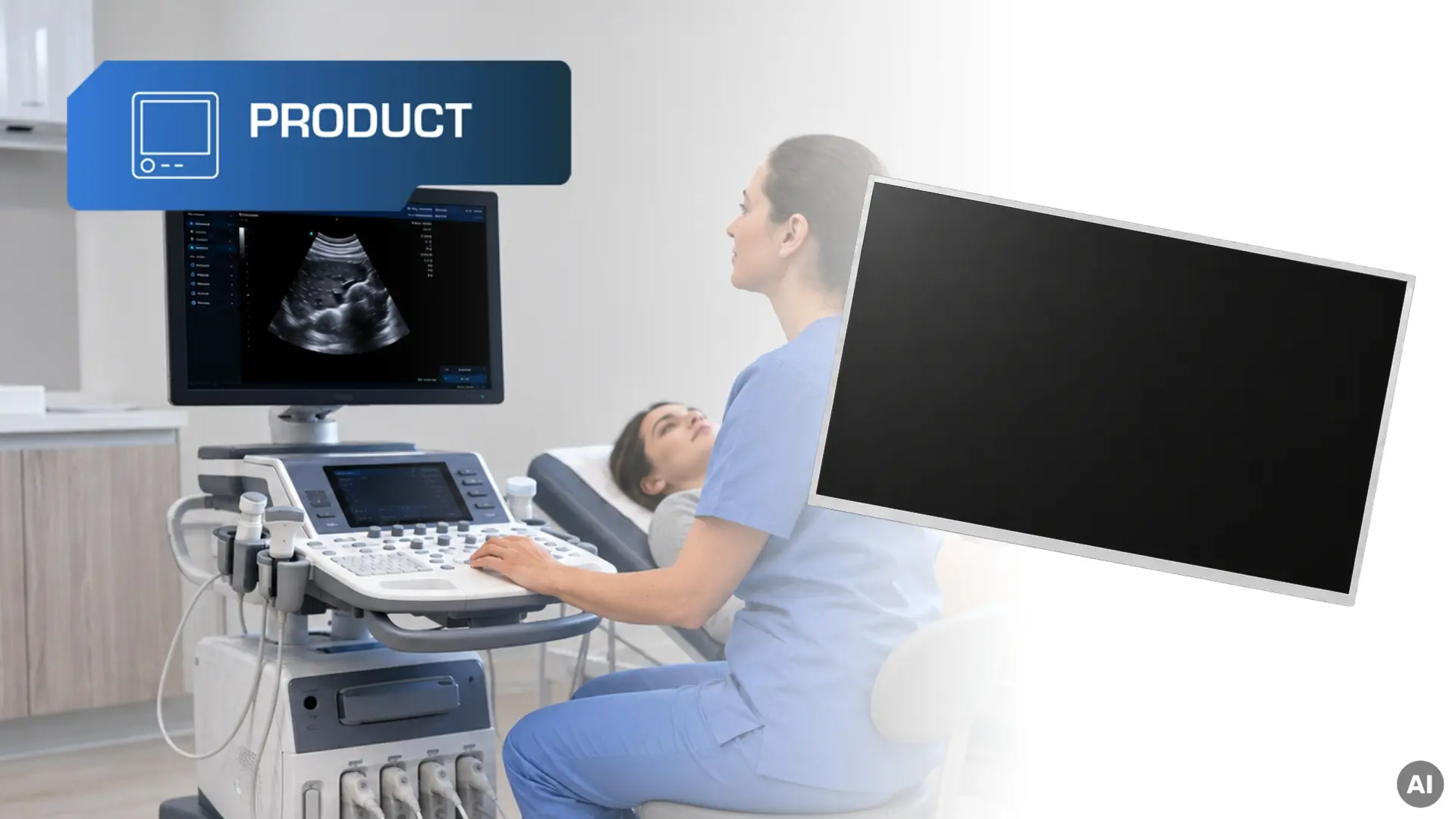
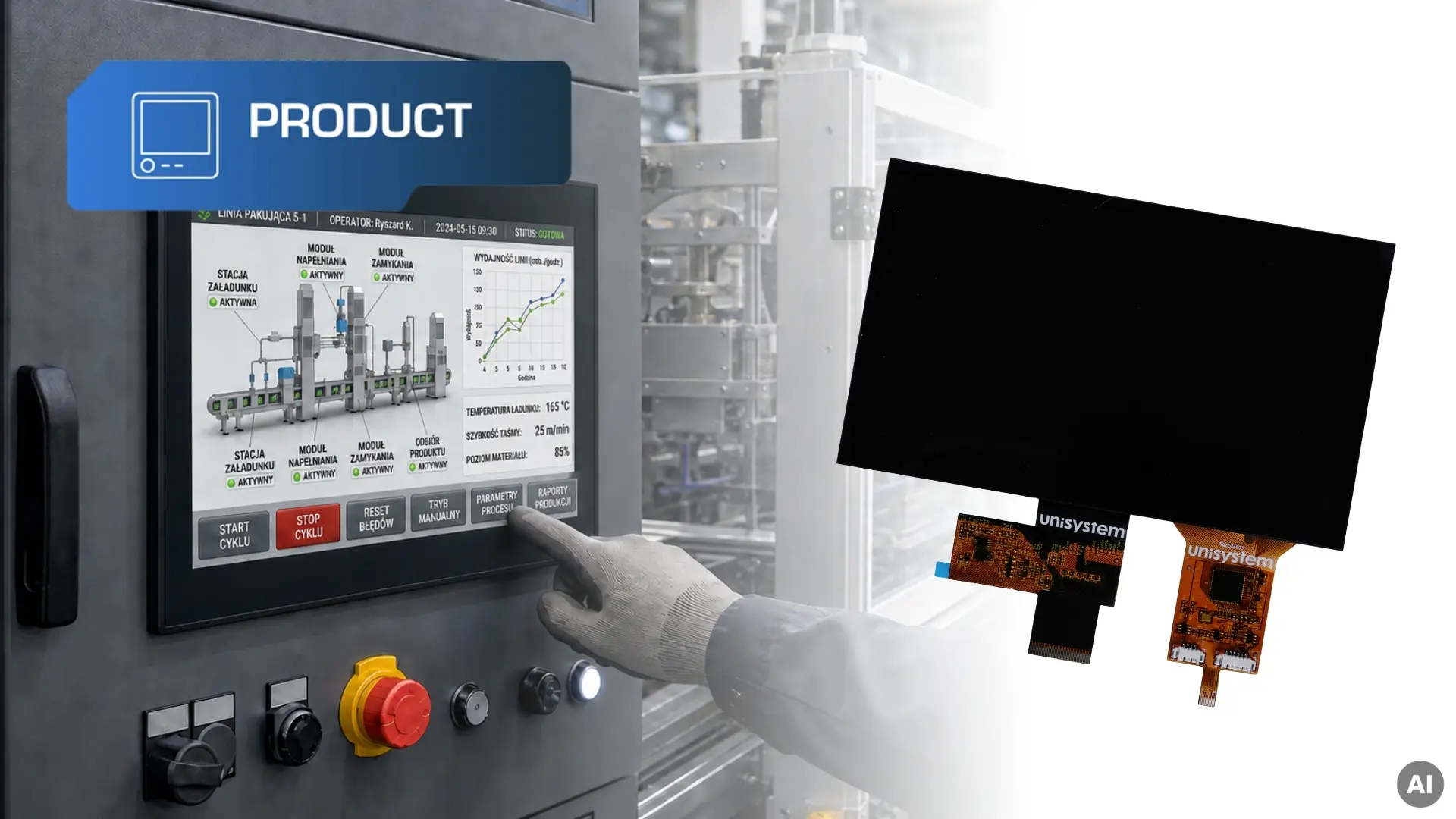
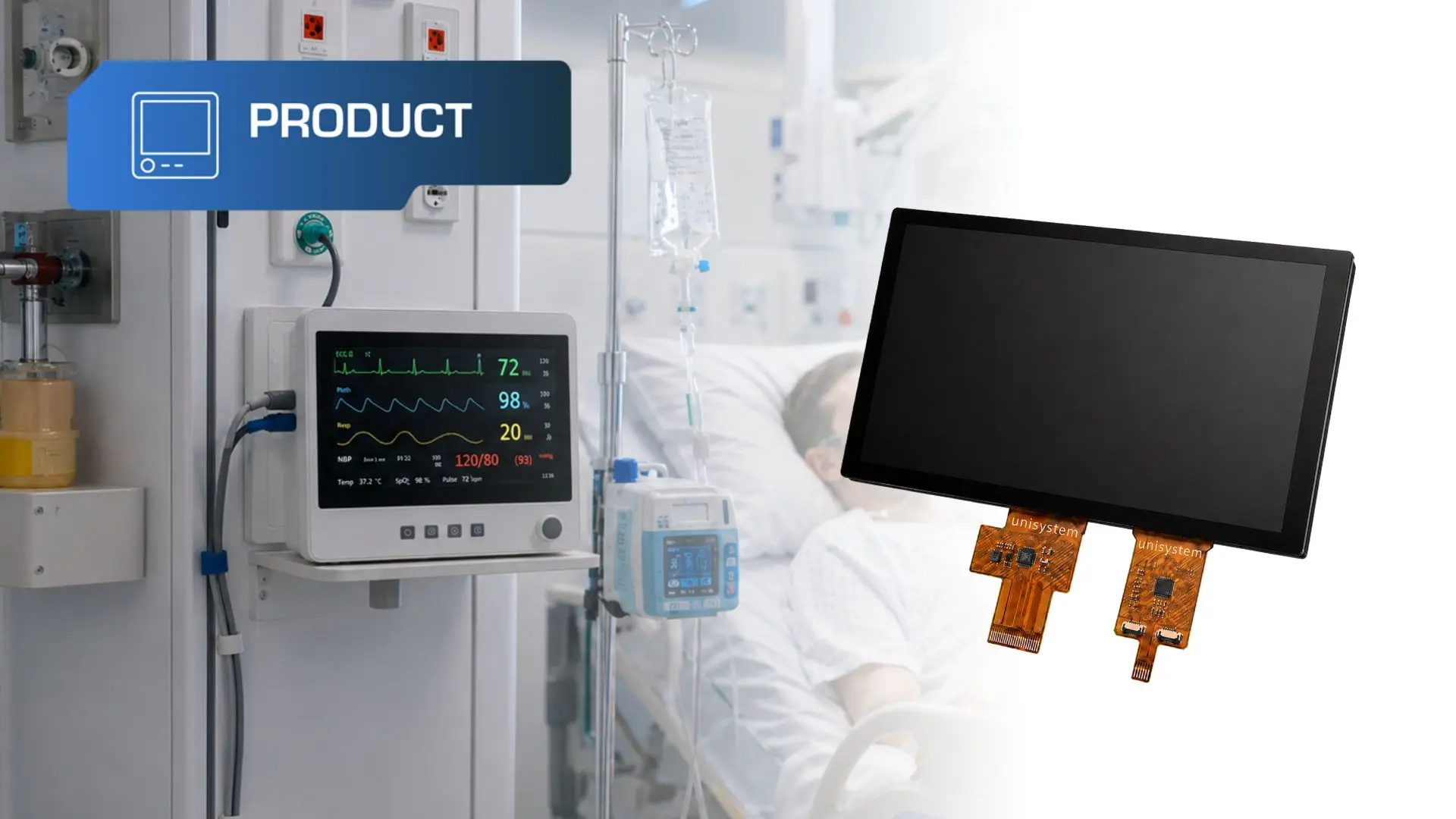
Core can be used in a wide range of industrial devices where the display is an important part of the user interface. It is suitable for HMI panels, machine control systems, measuring devices, self-service terminals, medical and laboratory equipment, and continuously operating devices.
It is a good choice for projects that require stable performance in everyday, intensive operation.
Unisystem Pro – stable operation where conditions are most demanding
Unisystem Pro is a line of LCD-TFT displays designed for the most demanding applications, including outdoor devices. It is intended for projects where the screen must remain readable in strong light, operate stably despite changing ambient conditions, and withstand intensive use. Pro is well-suited to applications where the display must maintain readability and durability despite exposure to sunlight, frequent user interaction, and an increased risk of mechanical damage.
Key features of the Pro line:
- display brightness: 2000 cd/m² (1700 cd/m² in the touch panel variant);
- touch function based on the ILITEK ILI2520 controller;
- UV layer protecting components against degradation caused by solar radiation;
- 4 mm protective glass as standard, providing IK08 mechanical impact resistance;
- MTBF: up to 100,000 hours.
Brightness of 2000 cd/m² – or 1700 cd/m² for the module with a touch panel – helps maintain optimal image readability even in intense lighting conditions, including direct sunlight. This is particularly important for devices installed outdoors, where lighting conditions may change dynamically throughout the day. In such applications, the UV layer is also important, as it helps reduce material degradation caused by solar radiation and supports long-term module operation in outdoor environments.
The 4 mm protective glass, with IK08 mechanical impact resistance, increases the module’s resistance to damage from intensive use, including accidental impacts, pressure, or deliberate attempts to damage the screen.
As a result, the Pro line is prepared for environments where a standard display would not provide sufficient readability, durability, or operational stability.
Example applications for products from the Pro line
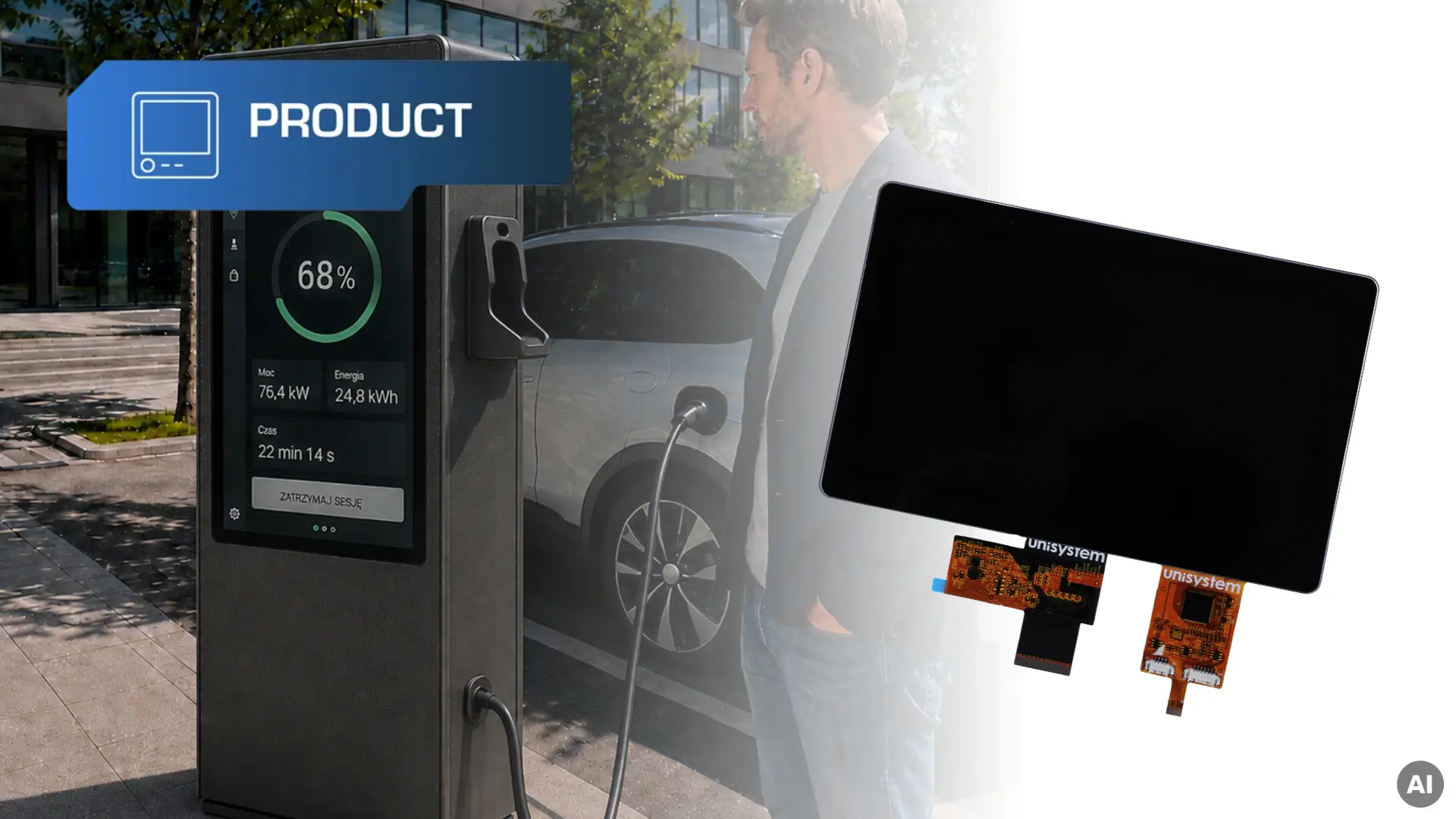
The Pro line is intended for devices installed outdoors, including environments with higher operational requirements. It is well-suited to kiosks, ticket machines, parking meters, parcel lockers, passenger information systems, and other solutions that must operate reliably despite changing ambient conditions.
It is a suitable choice for manufacturers designing devices that require high readability, structural robustness, and stable operation in demanding conditions.
ILITEK ILI2520 controller – precise touch configuration for the application
In touch panel variants, the Core and Pro lines use the ILITEK ILI2520 controller, enabling fine-tuning of touch interface performance to the operating conditions of a specific device. This is particularly important in professional applications, where the touch panel should remain stable despite intensive use, environmental interference, or changing operating conditions.
Touch parameter configuration is especially important wherever the panel may be exposed to factors that make operation more difficult – for example, the presence of water or other substances, such as oils, greases, or gels, on the screen surface, as well as electromagnetic interference in the device’s operating environment. Proper adjustment of sensitivity and signal filtering helps reduce the risk of accidental activations, known as ghost touch, while maintaining a stable interface response.
Operation with gloves is a separate challenge, particularly relevant in industrial, medical, and laboratory applications. Proper calibration enables increased interface sensitivity, ensuring the screen responds correctly to touch through glove materials like latex or nitrile, while still reducing the risk of accidental activations.
As a result, the touch panel can operate predictably not only in test conditions but, above all, in the device’s real working environment. This supports more stable operation, reduces the risk of false activations, and allows the interface to better match the requirements of a specific application.
Optical bonding as standard in modules with a touch panel
In touch panel variants, the Lite, Core, and Pro lines use optical bonding, which means full-surface bonding of the display, touch panel, and protective glass using a transparent optical layer. This solution improves image readability, reduces light reflections,, and increases contrast, which is important in both indoor applications and more demanding operating environments.
Optical bonding also contributes to the durability of the entire module. Full-surface bonding increases structural rigidity and helps distribute forces acting on the screen more evenly, for example, during pressure, vibration, or impact. It also reduces the risk of dust, particles, and moisture entering the space between the module layers, while lowering the likelihood of screen fogging during sudden temperature changes.
In terms of durability, the UV resistance of the materials used is also important. The modules include a UV-resistant layer that helps protect the glass’s visual elements from fading and degradation. The OCA adhesive layer used in the optical bonding process is also UV-resistant. As a result, the module can maintain optical stability, appearance, and reliability for longer in applications exposed to intense light and changing operating conditions.
Optical bonding improves user comfort and supports predictable device operation. This is particularly important in applications where the screen serves as the main user interface, such as HMI panels.
Unisystem as a designer and manufacturer of display-based solutions
The introduction of the Lite, Core, and Pro lines marks the next stage in Unisystem’s development – as a company that combines distribution experience, engineering expertise, and its own design and production capabilities. For more than three decades, we have been supporting customers in the field of display technologies, using the know-how we have gained to develop solutions tailored to the requirements of specific industries – now also in the form of our own products.
The Solution department plays a particularly important role in this process. It is an interdisciplinary team working on complete technological solutions – from customer needs analysis, through design and prototyping, to testing, validation, and preparation for implementation. The department’s competencies include, among others, the design of display and touch panel modules, protective glass customization, FPC cable modifications, selection of adhesive layers, integration of additional electronics, and the design of mounting elements.
As a result, Unisystem’s new products can be treated not only as ready-made LCD-TFT modules, but also as a basis for further customization. If a project requires the product to be adapted to a specific enclosure, operating environment, mounting method, or functional requirements, we can support the customer at subsequent stages of solution development. This is particularly important for manufacturers of industrial devices who are looking not only for a component, but for a partner who understands the design process, technical and business constraints, and the challenges involved in bringing the final product to market.
The division into three product lines – Lite, Core, and Pro – makes it easier to match the display to the device’s operating conditions. As a result, manufacturers can choose a solution that meets the project requirements, without overspecifying the design or compromising technical parameters when the application requires higher levels.
Want to learn more about Unisystem’s new LCD-TFT display lines? Contact our team and find out which solution best matches the requirements of your application.