Article summary generated by AI — it may contain errors.
Table of contents
Displays used in portable, measuring, and battery-powered devices must meet different requirements than conventional screens designed for applications with advanced graphics. Key considerations include not only readability, but also exceptionally low power consumption, stable presentation of static content, and reliable operation under changing lighting conditions.
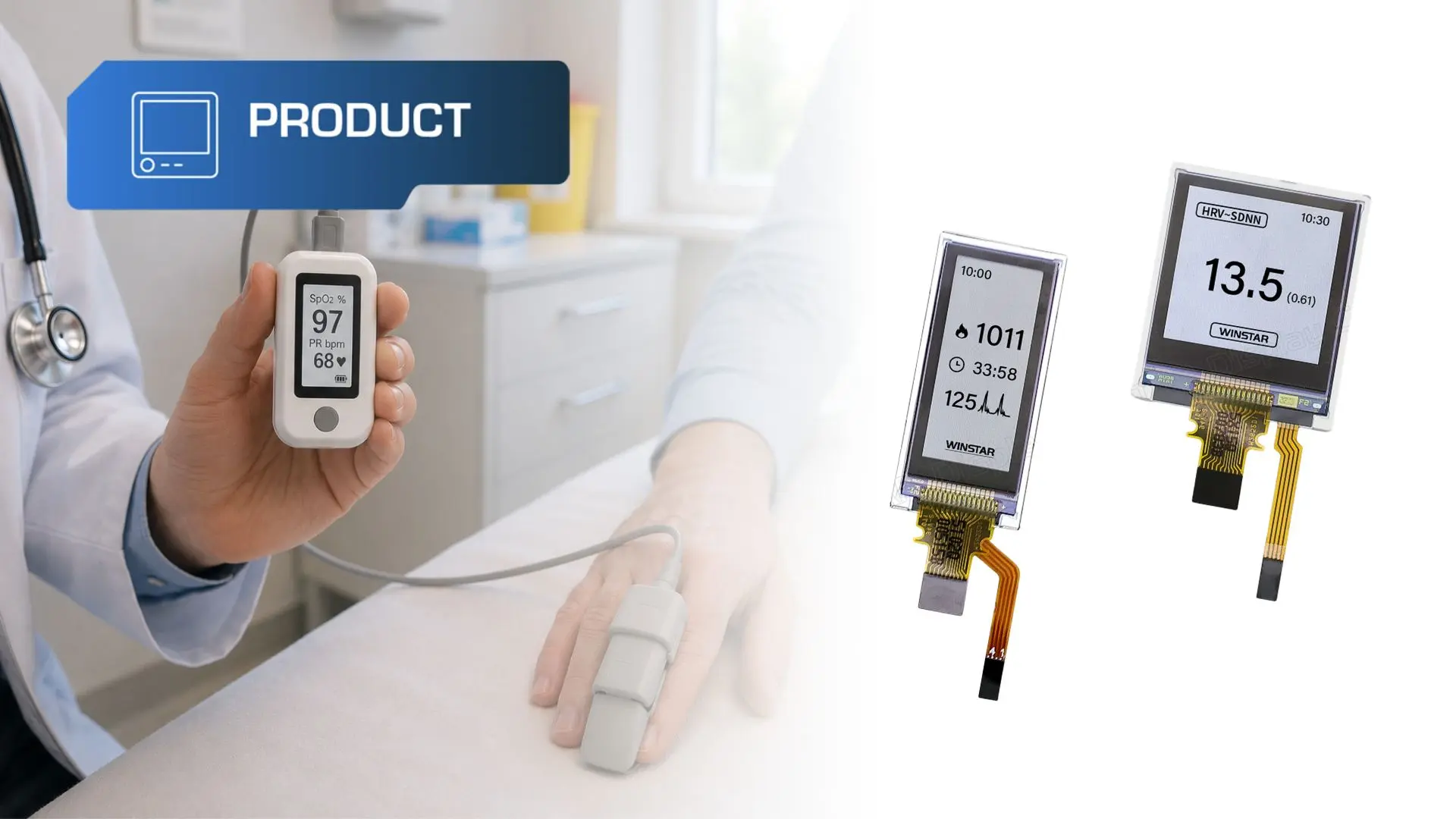
These requirements are met by Winstar’s MIP (Memory in Pixel) displays: the WFM0103A2TABASNN000 and WFM0108A2TAJASNN000. These compact, reflective monochrome modules are intended for applications in which the screen primarily presents text-based data, symbols, simple icons, or information that is updated relatively infrequently.
MIP Technology – Memory Integrated into Each Pixel
Memory in Pixel (MIP) is an LCD technology in which every pixel incorporates a small memory cell. In simple terms, each point in the image “remembers” whether it should remain light or dark at a given moment. As a result, the entire screen does not need to be continuously refreshed when the displayed information remains unchanged.
In conventional LCDs, the image is refreshed regularly by the control electronics. This means that image data is repeatedly transmitted to the panel even when the same content remains on the screen for an extended period. MIP technology works differently: pixel states are stored directly within the panel, allowing the system to update only the areas that actually need to change.
In practice, when only a single digit, status icon, battery indicator, or short message changes, the system does not need to retransmit the entire image. Instead, it can update only selected lines or sections of the screen. This reduces the amount of transmitted data, lowers the workload on the control unit and decreases power consumption. However, this does not mean that the panel requires no periodic activity at all. A continuous power supply is still needed to maintain proper operation of the matrix, but there is no need to continuously transmit a complete image frame.
This is particularly important for battery-powered devices that primarily display simple, static, or infrequently updated information, such as device status, measurement results, the time, battery level, or basic user interface elements.
Reflective Structure and Readability in Bright Environments
The WFM0103A2TABASNN000 and WFM0108A2TAJASNN000 use reflective technology and incorporate an LED backlight. This means they rely primarily on ambient light to display the image, while the backlight serves a supporting role, improving readability in low-light conditions. Visibility in bright environments is therefore determined mainly by the panel’s reflective structure rather than by the brightness of the backlight.
MIP technology combines this reflective method of image presentation with the pixel-integrated memory described above. As a result, the screen can use ambient light without continuously refreshing the entire image. It is this combination of reflective operation and pixel memory that enables good readability while maintaining very low power consumption.
In bright surroundings, this design supports image readability because the screen uses ambient light rather than competing with it with a powerful backlight. This distinguishes reflective MIP displays from many conventional transmissive LCDs, which require high backlight brightness to remain readable in strong daylight.
The reflective structure makes these MIP modules well-suited to applications in which the device operates in daylight or under artificial lighting, including outdoor locations, semi-open environments, and well-lit measuring stations. They are therefore designed to provide optimal readability in bright surroundings, including selected outdoor applications.
However, final visibility in direct sunlight depends on the design of the complete device, including the protective cover glass, anti-reflective coatings, enclosure, screen angle, and the size of the fonts and icons used.
WFM0103A2TABASNN000 – 1.03″ Square MIP Display
The WFM0103A2TABASNN000 is a compact black-and-white MIP display with a 1.03″ diagonal and a 128 × 128 px resolution. Its square format makes it well-suited for presenting simple icons, symbols, indicators, compact menus, and basic measurement data.
The module measures 24.29 × 28.66 × 1.78 mm, with an active area of 18.56 × 18.56 mm. Its compact dimensions facilitate integration into small electronic devices with limited installation space.
The model features an SPI interface, simplifying integration with microcontrollers used in portable and low-power devices.
WFM0108A2TAJASNN000 – 1.08″ Elongated MIP Display
An alternative option is the WFM0108A2TAJASNN000, a 1.08″ MIP display with a resolution of 160 × 68 px. Unlike the 1.03″ model, it has an elongated format suited to applications that require short messages, numerical values, status information, or text to be presented within a narrow area.
The module has a monolithic design, measures 32 × 14 × 2.08 mm, and provides an active display area of 25.28 × 10.744 mm. Its elongated format and low profile make it suitable for devices with narrow or compact enclosures, where the available screen space is limited but basic information must remain clearly readable.
The model uses an SPI interface, facilitating integration with microcontrollers commonly used in portable and low-power devices. As this standard is widely supported, the module can be readily incorporated into both new designs and upgrades of existing devices.
The table below compares the key technical specifications of both models:
| Parameter | WFM0103A2TABASNN000 | WFM0108A2TAJASNN000 |
| Size | 1.03″ | 1.08″ |
| Resolution | 128 × 128 px | 160 × 68 px |
| Interface | SPI | SPI |
| Outline dimensions | 24.29 × 28.66 × 1.78 mm | 34.84 × 16.17 × 2.08 mm |
| Active area | 18.56 × 18.56 mm | 25.28 × 10.744 mm |
| Colour | monochrome, black and white | monochrome, black and white |
| Contrast ratio | 20:1 typ. | 20:1 typ. |
| Supply voltage | 2.7–3.3 V | 2.7–3.3 V |
| Operating temperature range | –20°C to +70°C | –20°C to +70°C |
| Surface treatment | hard coating | hard coating, anti-glare |
| Touch panel | none | none |
| LED lifetime | 50,000 h | 50,000 h |
Low-Power Operation in Battery-Powered Devices
One of the key advantages of both models is their exceptionally low power consumption, particularly important for battery-powered devices. However, it is important to distinguish between the power consumed by the LCD panel itself and the module’s total power consumption when the LED backlight is active.
When the displayed image remains unchanged, the LCD panel in either model typically consumes just 15 µW. Even when the image is refreshed at 1 frame per second, power consumption remains low, with typical values of 45 µW for the WFM0103A2TABASNN000 and 25 µW for the WFM0108A2TAJASNN000. These values refer solely to the panel’s operation.
When the LED backlight is switched on, power consumption increases to tens of milliwatts. The backlight should therefore be regarded as an auxiliary feature rather than the primary mode of low-power operation. How it is used depends on the device’s design: it may be activated periodically, switched on by the user, or controlled by the device’s electronic system. Automatic brightness adjustment would require additional components and functionality, such as an ambient light sensor and appropriate control implemented in the electronics or application software.
This solution is particularly well-suited to applications that do not require smooth animations or advanced graphics, and in which the screen’s primary function is to present essential information continuously and clearly.
SPI Interface and Integration with Control Electronics
Both models communicate with the system via an SPI interface. This widely used serial interface is commonly found in microcontroller-based devices. In practice, it simplifies integration with basic control electronics without requiring advanced graphics controllers.
The ability to update selected lines or sections of the screen reduces the amount of data transmitted through the interface, which is particularly important in low-power applications.
Typical Applications of Winstar MIP Displays
With their low power consumption, compact dimensions, and good readability in bright environments, the WFM0103A2TABASNN000 and WFM0108A2TAJASNN000 are well suited to portable, battery-powered, and low-power devices that display static or infrequently updated data, status information, and short messages.
Typical applications include:
- meters and data loggers – devices that present measurement results, numerical values, operating status, or battery level,
- testers and diagnostic equipment – compact service, inspection, or measurement tools in which the screen serves as a basic user interface,
- basic medical and laboratory equipment – auxiliary devices, analyzers, dispensers or compact diagnostic instruments that present results, operating status, messages or essential user information in non-critical applications,
- status indicators and information modules – compact screens used to present messages, symbols, icons, alarms, or device status information,
- meters and monitoring systems – smart meters, always-on devices, and basic interfaces for presenting operational data,
- electronic labels and identification devices – labels, tags, identifiers, or compact information screens used to present short text messages.
Summary
The WFM0103A2TABASNN000 and WFM0108A2TAJASNN000 by Winstar are compact MIP displays designed for applications where low power consumption, readability, and a small form factor are key priorities. With memory integrated into each pixel, they can retain an image without continuously refreshing the entire screen, while their reflective structure uses ambient light to enhance readability.
Not sure which MIP display is best suited to your application? Contact us. We will help you select a solution that meets the project requirements, power supply constraints, operating conditions, and preferred integration method.