
Article summary generated by AI — it may contain errors.
Table of contents
Electronics manufacturing requires not only selecting the right components, but also ensuring that they are available when needed. Even a well-planned project can be delayed if a display, touch panel, custom electronics or another component required for final product assembly is unavailable.
Continuity of supply becomes particularly important for components with longer lead times and solutions tailored to the requirements of a specific application. Replacing them quickly with an alternative may be impossible or may require additional integration work, testing and validation.
One way to make the procurement process more structured is to place a blanket order. This allows a specified quantity of products to be ordered and then delivered in batches according to a previously agreed schedule. Such an arrangement can make deliveries more predictable, reduce the risk of production downtime and simplify production planning, without requiring the entire order to be delivered at once.
In this article, we refer to Unisystem’s General Terms and Conditions of Sale (GTCS). This document sets out the key terms of commercial cooperation, including the fulfilment of blanket orders. The current version of the GTCS is available here: https://unisystem.com/general-terms-and-conditions-of-sale.
What is a blanket order?
Under Unisystem’s General Terms and Conditions of Sale, a blanket order allows customers to secure a larger quantity of products and take delivery in batches at later dates. The customer orders the entire agreed quantity, while the schedule for individual deliveries and the final delivery date are established in line with their production plan.
For example, a device manufacturer may order 3,000 displays for an annual production program. Instead of receiving the entire quantity at once, the manufacturer can arrange six deliveries of 500 units, scheduled according to the expected consumption of the component.
A blanket order is binding. It covers a specified quantity of products that the customer undertakes to receive within the agreed timeframe.
Why are blanket orders important in the electronics industry?
Electronic components are not always available at short notice, so deliveries need to be planned well in advance. Before a product reaches the customer, materials may need to be ordered, followed by production and quality control, as well as transport and customs clearance. At the same time, many projects require a specific component configuration to remain unchanged throughout the production period. This is particularly important for displays, where changing even a single element may affect:
- the optical performance of the device,
- how the display is driven,
- the mechanical design,
- the location and design of connectors,
- electromagnetic compatibility,
- touch panel operation,
- software and the user interface,
- the results of tests carried out previously.
For custom solutions, the number of dependencies is even greater. A product may combine a display with a dedicated touch panel, cover glass, a modified FPC, control electronics or mechanical components. Such a configuration usually cannot be replaced with just any component offering a similar screen size and resolution.
A blanket order can therefore serve two purposes. It structures logistics and delivery schedules while also helping secure the availability of the specific product required to maintain production continuity.
How does a blanket order work at Unisystem?
Fulfilling a blanket order requires both the total quantity of products and a delivery schedule to be agreed. Under the GTCS, a blanket order can only be accepted once the delivery schedule and the final date for receiving the entire quantity have been specified.
Determining demand
The first step is to estimate the total demand for the component. The customer should specify:
- the product or solution covered by the order,
- the total quantity,
- the expected consumption in each period,
- the required quantities for individual deliveries,
- the preferred delivery dates,
- the final date for receiving the entire quantity.
Agreeing the delivery schedule
The schedule specifies how the total quantity will be divided into individual deliveries. It may include regular batches delivered monthly, quarterly or every six months, but it can also be tailored to an irregular production plan.
Order confirmation
Unisystem then formalizes the order submitted by the customer in a document specifying the terms of fulfillment, referred to as the order confirmation. It sets out the key terms, including the price, total order value, place and method of delivery, and payment terms. The contract is concluded when the customer receives this document.
Upon receiving the order confirmation, the customer should carefully check the product designation, quantity, price and total order value, delivery schedule, final delivery date, company details, delivery address and payment terms. If any provision differs from the previous arrangements or the information provided in the order, the discrepancy should be reported to the sales representative so that it can be clarified and the correct details confirmed.
Preparing or sourcing the products
The fulfillment process depends on the type of product. For a standard solution, it may involve placing an order with the manufacturer.
For custom solutions, the process may also include:
- ordering base components,
- preparing a dedicated touch panel,
- manufacturing the cover glass,
- modifying the connection cable,
- integrating additional electronic and mechanical components.
In such cases, the delivery schedule should allow for the full lead time required to prepare the solution.
Deliveries according to the agreed schedule
Products covered by a blanket order are delivered according to the agreed schedule. All deliveries should be completed by the specified final delivery date.
It is important to note that the dates stated in the order confirmation are estimates. They may change due to factors such as extended production lead times, limited component availability, or transport delays. If this happens, we inform the customer of the revised estimated delivery date.
What is a blanket order call-off?
A call-off is a customer’s request for products covered by a blanket order to be delivered earlier than scheduled. This option may be used, for example, when production is brought forward, additional demand arises, or component stock is depleted faster than expected.
For a request to be treated as a call-off, it should clearly identify the blanket order to which it relates. The customer should therefore provide the order number, product code or name, required quantity, preferred delivery date and delivery address if it differs from the one agreed previously.
Whether the call-off can be fulfilled as requested depends on product availability. If only part of the requested quantity is currently in stock, the delivery may be limited to the number of units available. If the customer has several open blanket orders, the call-off is fulfilled first against the earliest order. A single delivery may include products from several blanket orders.
What obligations are associated with a blanket order?
A blanket order is binding and covers a specified quantity of products that the customer undertakes to receive. Spreading deliveries over time does not reduce the total quantity ordered. It should therefore not be treated as a demand forecast that can be freely adjusted at a later stage. The order quantity should be determined using the most realistic available data on planned production volumes and component consumption.
Meeting the final date for taking delivery
The final date for taking delivery is specified in the terms of each individual order. How this date is determined may depend, among other factors, on whether the product is available from Unisystem’s stock or must first be sourced or manufactured.
Individual terms may be agreed during commercial negotiations and subsequently included in the quotation and order confirmation. These documents set out the specific terms applicable to the order. Before placing it, the customer should therefore carefully review the delivery schedule and the final date for receiving the entire quantity.
Responsibility for providing accurate information
Before placing an order, the customer should carefully check the product part number, specification and quantity. This is particularly important for components manufactured on the basis of technical documentation provided by the customer.
Under the GTCS, the customer is responsible for the accuracy of the technical information provided. It should therefore be thoroughly reviewed before the order is placed. Unisystem fulfils the order based on the specification received and does not carry out a full technical review of it each time.
Product verification before placing a larger order
If the product has not previously been used in the device concerned, it is advisable to begin by testing samples before ordering a larger quantity. This allows its optical, electrical, mechanical and functional performance to be assessed in the intended application. Once the tests have been completed successfully, the specific part number can be approved for use in series production.
Unisystem’s General Terms and Conditions of Sale also set out the rules applicable to orders placed without samples having been ordered beforehand. These rules apply to orders of at least 10 units. In such cases, the customer should carefully review the product description and technical specification. If the products supplied comply with the information available at the time the order was placed, the customer undertakes to receive the entire quantity ordered.
If the customer decides not to order and test samples beforehand, Unisystem may decline the order, particularly where it is not possible to determine whether the product will be suitable for the intended application without prior verification.
Sample testing is particularly important for customised solutions developed to meet the requirements of a specific project. Before a larger batch is produced, the final configuration must be confirmed and approved for series production.
Blanket orders – benefits, risks and limitations
A blanket order can simplify delivery planning and help secure component availability, but it also involves specific commitments. The table below summarises the main benefits, risks and limitations, taking into account the project stage, the nature of the component, the predictability of demand and the minimum order quantity (MOQ).
| Area | Benefit | Risk or limitation |
| Delivery predictability | Defining demand in advance makes it easier to plan procurement and subsequent production runs. | A plan based on inaccurate forecasts may result in component shortages or excess stock. |
| Production continuity | Securing a larger quantity reduces the risk of a key component becoming unavailable and causing production downtime. | A blanket order does not eliminate every potential delay, including those related to production or transport. |
| Component lead time | This arrangement is particularly useful for products with long or variable lead times. | If the component is readily available and can be reordered quickly, maintaining a larger buffer may be less justified. |
| Delivery schedule | The total quantity can be divided into several deliveries aligned with expected consumption and successive production runs. | The customer is required to receive the entire quantity ordered by the agreed final delivery date. |
| Storage | Partial deliveries reduce the number of components that the customer needs to store at any one time. | Delayed collection or receipt of the products may result in additional costs and logistical complications. |
| Configuration stability | Ordering a larger quantity makes it easier to maintain the same component version, particularly when using an alternative would require design changes or additional testing. | Changes to the device specification or design may leave the customer with unused stock. |
| Custom solutions | A blanket order helps secure the availability of a display or module developed to meet the requirements of a specific project. | The more closely a solution is tailored to a single application, the fewer options there are for using it if the project requirements change. |
| Inventory financing | Spreading deliveries over time allows component receipt to be better aligned with the pace of production. | A binding order may tie up capital in products that will not be used until a later date. |
| Operational flexibility | If demand increases earlier than expected, the customer can submit a call-off request. | Whether an earlier delivery can be made depends on current product availability. |
| Project stage | This arrangement works well for stable series-production projects in which prototyping has been completed and component consumption can be estimated reliably. | It is less suitable during prototyping, before testing has been completed or while the mechanical design is still being finalised. |
| Product verification | Testing samples in advance allows the product to be approved before a larger quantity is ordered. | Placing an order before validation has been completed increases the risk of selecting a component that is unsuitable for the intended application. |
| Project life cycle | In a stable, long-term project, a buffer can support regular production over successive periods. | Uncertain sales volumes, planned product changes or an unpredictable project lifetime increase the risk of being left with unused stock. |
| MOQ and order quantity | A blanket order can make it easier to meet the MOQ, meaning the minimum number of units required for a single order, while allowing the products to be delivered over time. | If demand is low or irregular, the MOQ may result in a larger order than the project actually requires. Standard orders for smaller batches must also comply with the applicable minimum quantity. |
| Price | A larger order may provide access to more favourable pricing and greater predictability of purchasing costs. | If a price is agreed for the entire order, the customer remains bound by the agreed commercial terms even if the market price of the component decreases at a later date. |
How to prepare a realistic delivery schedule
The delivery schedule should be based on actual component consumption rather than solely on a general sales forecast for the final product. The production plan can serve as a starting point, but potential variations and logistical constraints should also be taken into account.
Before agreeing the schedule, it is advisable to analyse:
- historical component consumption,
- planned production run sizes,
- current inventory levels,
- the minimum safety stock,
- the expected lead time for the next order,
- seasonal fluctuations in production and sales,
- available storage capacity,
- the optimal quantity for each delivery,
- the expected project lifetime,
- the risk of design changes.
A simplified demand calculation can provide a useful starting point:
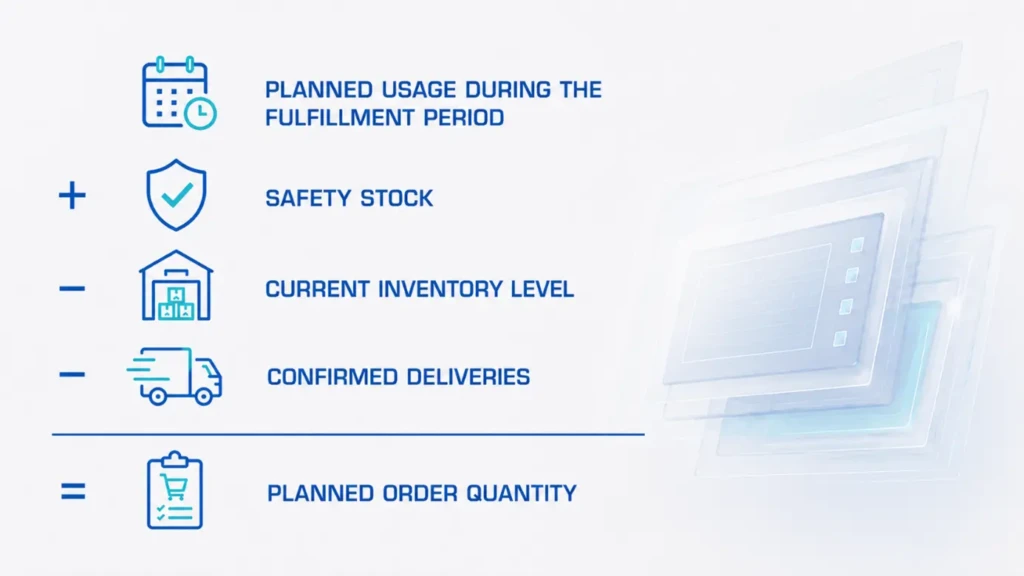
The resulting estimate should then be reviewed against the component lead time, standard pack quantities, production schedule and any anticipated changes to the project.
Safety margin
Every delivery schedule should include a safety margin. Its size depends on factors such as the component lead time, demand variability and the acceptable level of risk.
When determining the buffer quantity, it is important to strike the right balance, as both underestimating and overestimating it may adversely affect the project:
- A buffer that is too small increases the risk of component shortages, which may delay or halt production. This can occur, for example, due to production shortfalls, a sudden increase in demand or transport delays.
- A buffer that is too large may tie up capital and leave the customer with unused stock, particularly if the project is modified, scaled back or completed earlier than expected.
To strike the right balance, it is advisable to consider several possible scenarios, including demand below, in line with and above the forecast. This makes it possible to assess how changes in the pace of production would affect the buffer quantity and delivery schedule. The schedule should then be regularly compared with the current production plan to identify discrepancies at an early stage and discuss possible adjustments with the supplier. However, changes to the production plan do not automatically alter the terms of a confirmed order. Any change to a delivery date or quantity must be agreed in advance.
Common mistakes when planning blanket orders
When planning a blanket order, it is important to consider not only its total quantity, but also the delivery schedule, the project stage and communication with the supplier. The following mistakes are among those most likely to cause problems during order fulfilment:
- Treating the order as a non-binding forecast – a blanket order covers a specified quantity of products. The option to receive them in batches does not allow the customer to cancel the outstanding quantity if actual production is lower than expected.
- Ordering too large a quantity – an excessive buffer may leave the customer with components that cannot be used before the project changes or production of the device ends. The order quantity should reflect realistic demand rather than the most optimistic sales forecast.
- Placing an order before validation – placing a large order before testing the product increases the risk that problems will only become apparent after production has begun. This is particularly relevant to solutions developed to meet individual requirements.
- Failing to account for the final delivery date – spreading deliveries over time does not mean that the products can be stored indefinitely. The schedule must allow the entire quantity to be received by the agreed final delivery date.
- Informing the supplier about changes too late – if the production plan is brought forward or postponed, the supplier should be notified as early as possible. A call-off request can be used to request an earlier delivery, but whether it can be fulfilled depends on product availability.
- Failing to clearly identify a call-off request – a message requesting an earlier delivery should clearly indicate the specific blanket order to which it relates. Otherwise, it may be treated as a new order.
- Failing to account for standard pack quantities – electronic components are often supplied in specified pack quantities. Individual delivery quantities should be aligned with them where possible to simplify logistics and reduce the need to split packs.
*
A blanket order can make deliveries more predictable, but it is no substitute for sound planning. Its effectiveness depends on the accuracy of demand forecasts, the stability of the product specification and a well-prepared delivery schedule. This arrangement can be particularly useful for projects involving displays, touch panels and modules tailored to individual requirements, as it reduces reliance on last-minute purchases and makes it easier to coordinate deliveries with successive production runs.
Are you planning series production and looking to secure the availability of displays or other components? Contact our team. Based on the solution specification, expected demand and production plan, we will help you select the most suitable delivery model.