Article summary generated by AI — it may contain errors.
Table of contents
On 24 September 2026, we will take part in the next Gdańsk edition of TEK.day – an event bringing together representatives of the electronics industry. It will be a time for meetings, sharing experiences and exploring new technological solutions. The main theme of this year’s edition will be technologies for the military and marine sectors, where reliability, durability and the precise adaptation of components to operating conditions are particularly important. For us, it will also be an opportunity to present selected models from Unisystem’s own product lines. Meet us at AmberExpo – you will find us at booth 41.
What will you see at the Unisystem booth?
Selecting the right solution depends on how the device operates, the type of content presented, lighting and environmental conditions, as well as requirements related to operation and module design. Therefore, during the event, we will present various information display technologies, providing an opportunity to compare, test and assess them directly for specific applications.
LCD-TFTs: the launch of the Unisystem Lite, Unisystem Core and Unisystem Pro lines
At our booth, you will be able to see LCD-TFTs from our own product lines: Lite, Core and Pro. They have been developed for different operating environments and application requirements:
- Unisystem Lite – modules for devices operating indoors under stable conditions,
- Unisystem Core – the industrial standard for intensive use,
- Unisystem Pro – modules for devices operating outdoors, including demanding environments.
Each line is available in several configurations, making it possible to match the module to both the application requirements and the device design. Depending on the project, an LCD-TFT alone or a variant with a capacitive touch panel and cover glass can be selected.
Versions with cover glass are available with different finishing options tailored to the intended mounting method. You can choose a variant without factory-applied mounting tape, providing greater flexibility when designing the mounting system, or a version with mounting tape and appropriately finished corners, which facilitates the integration of the module with the enclosure and may streamline assembly in series production.
Variants with a touch panel also use optical bonding, which involves bonding the LCD-TFT, touch panel and cover glass over their entire surface using a specialist, optically transparent adhesive material. It fills the space between the individual layers, eliminating the air gap. As a result, light reflections are reduced, image contrast and readability are improved, and the entire module gains greater rigidity.
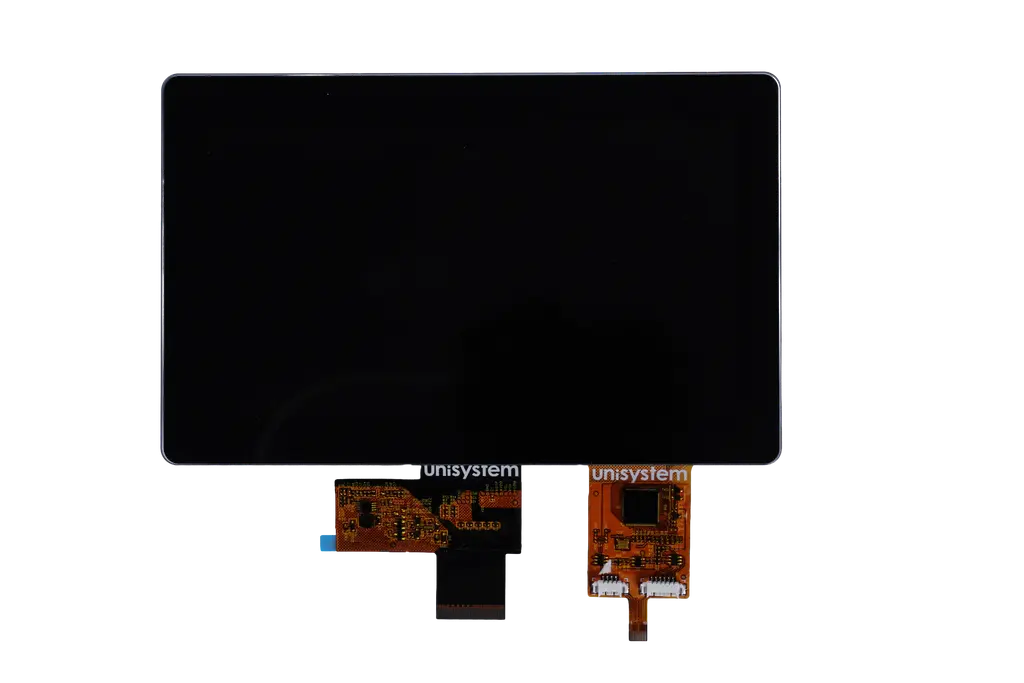
At one of our display stands, we will present 10.1-inch LCD-TFTs from the Lite, Core and Pro lines side by side, enabling a direct comparison of their brightness levels: Lite – 600 cd/m², Core – 750–1000 cd/m² and Pro – 2000 cd/m² (in the touch panel variants: 500 cd/m², 600–900 cd/m² and 1700 cd/m², respectively). This will make it possible to compare how differences in this parameter affect the way the image is perceived and to better assess which solution best matches the operating conditions and requirements of a given application.
Other information display technologies: OLED and EPD
In addition to our own LCD-TFT lines, we will present OLED and EPD technologies – each offers different properties and meets different requirements related to image presentation, lighting conditions and power consumption.
OLED is a technology in which each pixel emits its own light, so no additional backlight is required. This provides high contrast, deep blacks, wide viewing angles and a fast response time, making the solution well suited to devices presenting dynamic content and interfaces that must remain readable even in low-light conditions.
EPD (e-paper) uses pigment particles suspended in a mixture of oil and water, which move between electrodes under applied voltage to create an image. This technology is distinguished by very low power consumption – the image remains visible without a continuous power supply, and energy is consumed mainly when the content changes. It is therefore used, among others, in battery-powered devices and systems presenting static or periodically updated information.
Capacitive Touch Button by Unisystem
The solutions presented at the event will also include a capacitive touch button (UCB045-RGB-CMFDV1) by Unisystem, designed for intuitive and convenient device operation. It can be used both in new projects and when upgrading existing designs.
Our button detects touch through cover glass, can be operated while wearing gloves and remains stable even when liquid is present on the glass surface. RGB backlighting can indicate the device status or confirm that a command has been executed, while an optional buzzer provides additional audible feedback.

From Concept to a Finished Solution – Let’s Talk About Your Project
TEK.day is an opportunity not only to explore the latest solutions and trends in the electronics industry, but also to discuss specific project needs – from developing a new device and upgrading an existing design, through selecting a replacement component and exploring solution customization options, to challenges arising at subsequent stages of project implementation.
Support for such projects is provided by our Solution Department, which brings together specialists in electronics, mechanical design and software. The team is involved throughout the entire process – from needs analysis, through design, prototyping and testing, to preparing the solution for implementation.
You can read more about what this process looks like and how we respond to non-standard requirements in an interview with Jacek Marcinkowski, CTO at Unisystem: “Solution” in Practice – How Unisystem Responds to Real Customer Challenges.
Unisystem at TEK.day Gdańsk 2026
📅 Date: 24 September 2026
📍 Venue: AmberExpo, Gdańsk
🔍 Booth: 41
👉 Register: https://gdansk-en.tekday.pl/visitors#form.