Table of contents
Unisystem Lite is a line of LCD-TFT modules developed for devices operating indoors under stable and predictable conditions. It addresses the needs of projects that do not require components designed for the most demanding environments but still depend on a reliable, easy-to-integrate display with parameters tailored to the application. In this article, we explain the principles behind the Unisystem Lite line, discuss its intended applications and outline how to select the right variant for the design and operating requirements of a device.
The Unisystem display portfolio comprises three product lines designed for different application requirements:
- Unisystem Lite – modules for indoor devices operating under stable conditions,
- Unisystem Core – the standard solution for industrial applications,
- Unisystem Pro – modules for outdoor devices, including those operating under demanding conditions.
Dividing the portfolio into the Lite, Core and Pro lines makes it possible to match the module parameters to the actual requirements of a project without unnecessarily increasing the specification or cost of the solution.
The Origins of the Unisystem Lite Line
Our LCD-TFT lines draw on many years of experience in industrial projects and on the challenges associated with different types of applications. When working with electronics manufacturers, we analyse not only image parameters but also the mounting method, enclosure design, touch panel integration, control electronics, user interaction and the conditions in which the device will operate.
Many projects involve similar requirements, including easy integration, predictable parameters, a choice of configurations and stable product availability. At the same time, not every device requires components designed for continuous operation, high levels of electromagnetic interference, direct sunlight, extreme temperatures or rapid temperature changes.
Unisystem Lite was developed for devices used indoors under stable and controlled conditions. In these applications, the key requirements are excellent image readability, efficient integration and parameters suited to the actual operating environment.
Lite is not a simplified version of an industrial display. It is a solution designed specifically for a defined category of applications. It provides parameters that meet the requirements of indoor devices without relying on components intended for significantly more demanding conditions.
Would you like to learn more about Unisystem’s own products? Read our interview with Jacek Marcinkowski, CTO at Unisystem: New Products Developed by Unisystem – Industrial LCD-TFT Displays in Three Variants.
Unisystem Lite – Over a Dozen LCD-TFT Models
The Unisystem Lite line comprises more than a dozen variants that differ in diagonal size, resolution, interface, touch panel availability and protective glass design. This range makes it possible to select a configuration that matches the electronic architecture, mechanical design and intended method of operating the device.
The key characteristics of each module are encoded in its product designation – the part number (PN). The naming system used for products from the Lite, Core and Pro lines is explained in our guide: How to Read Unisystem Part Numbers – A Guide to the Lite, Core and Pro Lines.
The following sections discuss selected characteristics of Unisystem Lite displays that should be considered when choosing the right variant.
Sizes and Resolutions
Unisystem Lite modules are available in two popular sizes: 7.0” with a resolution of 1024 × 600 px (WSVGA) and 10.1” with a resolution of 1280 × 800 px (WXGA). These combinations of size and resolution provide optimal image readability and sufficient screen space for both simple and more complex user interfaces.
Variants with a Touch Panel
In addition to standalone LCD-TFT modules, the Unisystem Lite line includes variants equipped with a projected capacitive touch panel – PCAP.
Touch input is handled by the Goodix GT928 controller, which enables fast and precise interaction with the interface, including multitouch operation. As a result, mechanical buttons, switches and other external controls can be reduced or eliminated and replaced by functions available directly on the touchscreen.
Brightness
Unisystem Lite models provide a brightness of 600 cd/m² for the LCD-TFT panel alone and 500 cd/m² for variants equipped with a touch panel. The lower value in touch-enabled modules results from the additional optical layers through which the light emitted by the backlight must pass. Both values provide good image readability in indoor environments, including spaces with relatively intensive lighting.
Selecting the appropriate brightness level affects more than image readability. It can also help reduce power consumption, heat generation and the overall cost of the module.
RGB, MIPI and LVDS Interfaces
Depending on the configuration, Unisystem Lite modules are available with RGB, MIPI or LVDS interfaces.
RGB
RGB is a parallel interface in which data for the individual colour components and the synchronisation signals are transmitted over separate lines. It is supported by many microcontrollers and processors equipped with an LCD controller, making it possible to connect an LCD-TFT directly to the device electronics. However, the large number of signal lines requires careful connection design and PCB trace routing. RGB is mainly used in designs where the display and control unit are located close together and the number of required signal lines is not a significant constraint.
MIPI
MIPI DSI is a high-speed serial interface developed for transmitting image data to displays. Because it uses a relatively small number of signal lines, it reduces the number of connections and allows components to be arranged efficiently on the PCB. It is used primarily in compact designs where the display is located close to the processor. Using this interface requires a control unit equipped with a MIPI DSI controller.
LVDS
LVDS transmits image data over differential pairs. This method helps maintain signal integrity and reduces susceptibility to electromagnetic interference. The interface enables the stable transmission of large amounts of data, which is why it is commonly used with higher-resolution LCD-TFTs and in designs requiring a longer connection between the display and the control electronics.
RGB vs. MIPI vs. LVDS
The table below compares the key differences between RGB, MIPI DSI and LVDS from the perspective of integrating an LCD-TFT with the device electronics. The final choice should take into account not only the transmission method but also the capabilities of the control unit, the module resolution, connection design, power consumption and required interference immunity.
| Feature | RGB | MIPI DSI | LVDS |
| Transmission method | Parallel | Serial, differential | Serial, differential |
| Number of signal lines | 24 data lines – 8 for each of the R, G and B components – as well as VSync, HSync and DCLK lines | Usually 4 differential pairs, corresponding to 8 signal lines; some configurations may use fewer pairs | Usually 4 differential pairs, corresponding to 8 signal lines |
| Typical connection length | Short connections on the PCB or between components located close together | Short connections between the processor and the display | Can support longer connections than RGB and MIPI DSI |
| Interference immunity | Low – parallel, single-ended lines are susceptible to interference, crosstalk and increased electromagnetic emissions | Medium to high – differential transmission improves immunity, but the interface requires high-quality PCB and FPC design and careful trace routing | High – differential transmission provides strong immunity to interference and supports longer internal connections |
| Bandwidth and resolution | Best suited primarily to low and medium resolutions | High bandwidth, suitable for compact modules transmitting large amounts of image data | High bandwidth, suitable for higher-resolution modules |
| Power consumption | Usually higher due to the large number of active signal lines | Low, particularly in compact designs | Moderate, depending on the number of pairs and transmission frequency |
| Availability in control units | Widely supported by microcontrollers and processors equipped with an LCD controller | Requires a processor or system equipped with a MIPI DSI controller | Requires an appropriate LVDS transmitter or an additional converter |
| Integration complexity | Uses many lines but has a relatively straightforward operating principle | Requires fewer connections but more demanding routing of high-speed differential pairs | Requires correct impedance matching and differential-pair routing |
| Typical application | Designs with a short distance between the display and the control unit | Compact designs with a direct connection between the display and the processor | Designs requiring stable transmission, higher resolution or a longer connection |
Protective Glass
Protective glass is a standard component of Unisystem Lite modules equipped with a touch panel. It protects the display and touch panel against scratches, pressure and other forms of mechanical damage. The glass variant can be selected according to the mounting method and the design of the device front panel.
Two versions are available:
- protective glass without mounting tape,
- protective glass with mounting tape and rounded corners.
Protective Glass Without Mounting Tape
In this version, the protective glass does not include factory-applied mounting tape. This gives the designer greater flexibility when developing an individual method of mounting the module in the enclosure or front panel. The glass has a rectangular shape and can therefore be adapted to the mechanical design of the device.
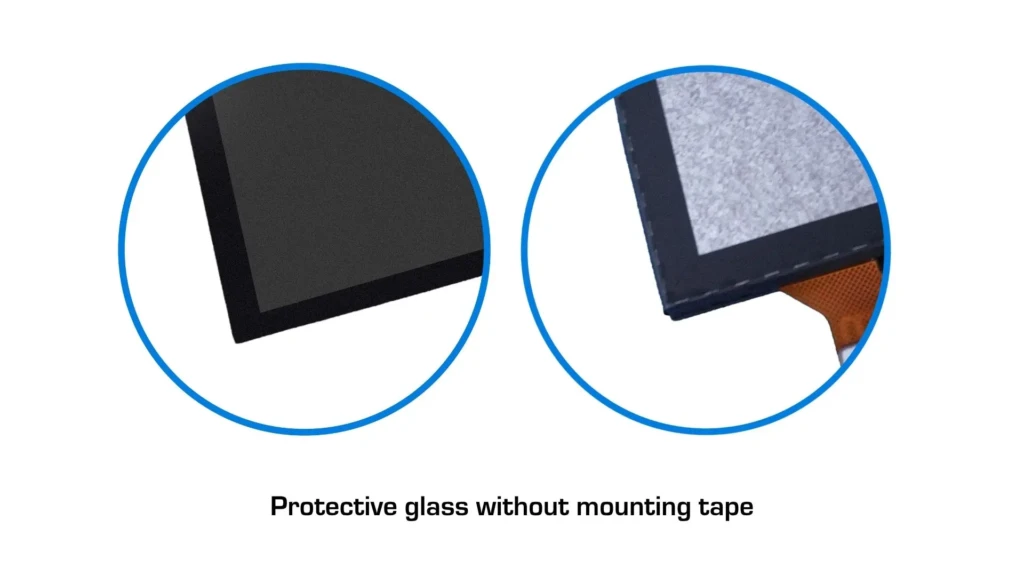
Protective Glass with Mounting Tape
In this version, the protective glass is fitted with mounting tape, making it easier to position and secure the module in the enclosure or front panel. This solution can simplify assembly and improve process repeatability during serial production. The glass also features rounded corners, giving the front of the device a softer visual finish.
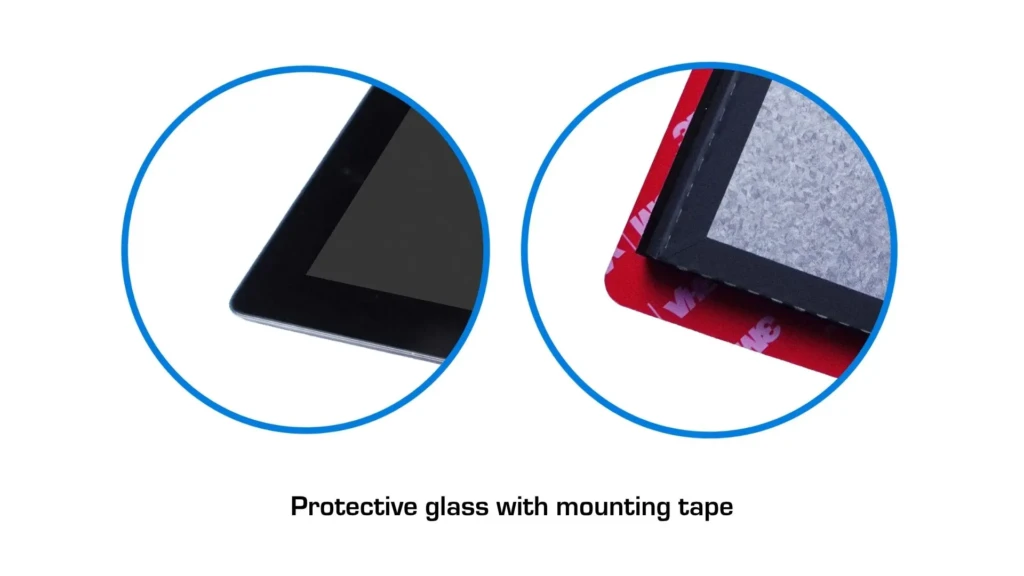
Optical Bonding
Both versions use optical bonding – a process in which the display, touch panel and protective glass are bonded across their entire surface using a transparent optical material. Optical bonding reduces internal light reflections, improves image contrast and readability, and increases the mechanical rigidity of the module.
Which Applications Are Unisystem Lite Modules Suitable For?
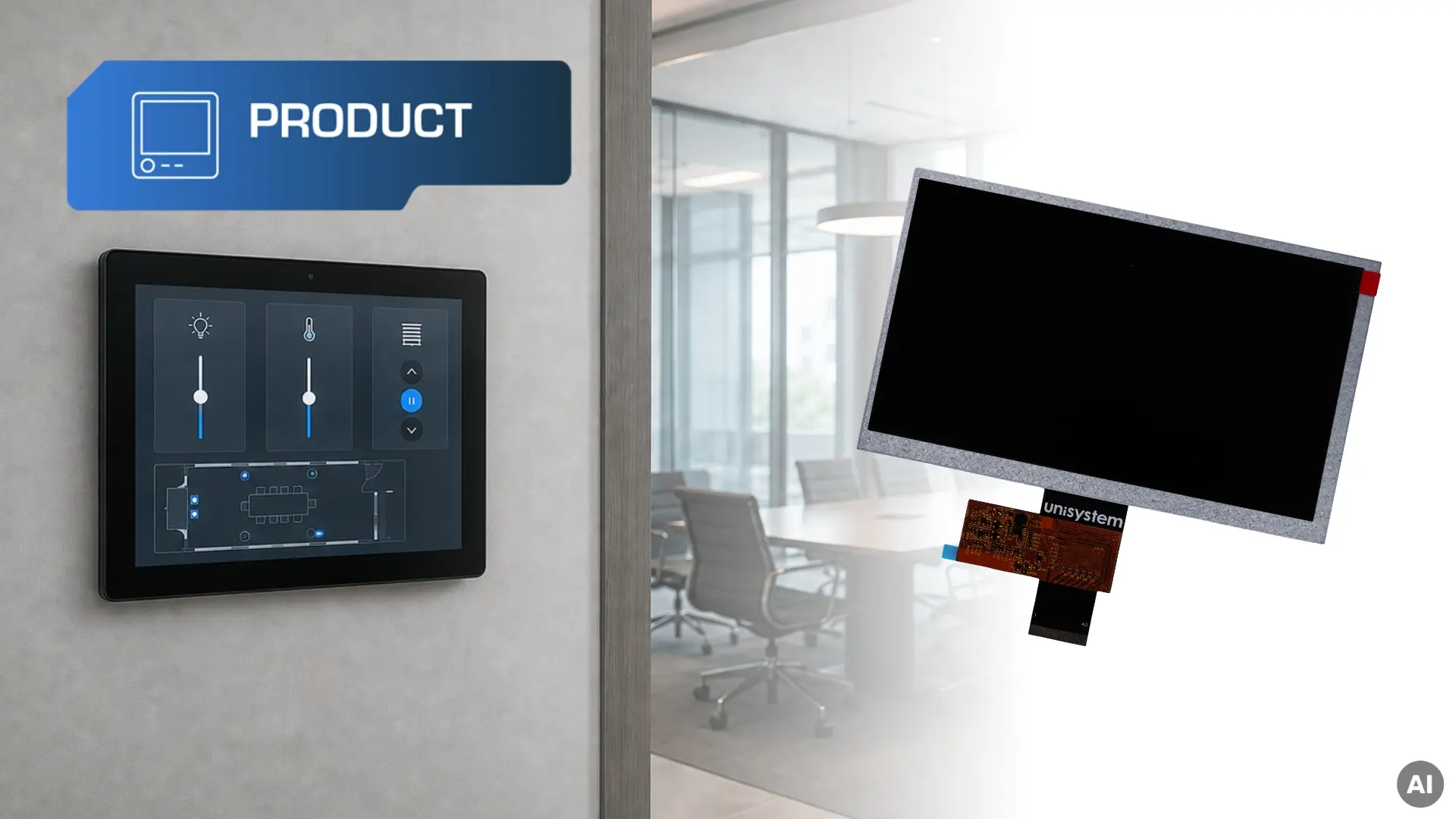
Unisystem Lite is intended for indoor devices operating under controlled conditions with moderate lighting and a stable temperature.
Typical applications include:
- operator, control and monitoring panels,
- building automation systems,
- information kiosks,
- self-service terminals,
- access control systems,
- medical and laboratory devices.
For projects involving more demanding operating conditions – such as more intensive lighting, heavier operational loads or higher levels of electromagnetic interference – the Unisystem Core line should be considered.
Are You Looking for a Solution Tailored to Your Project? Contact our team and tell us about your project requirements. Together, we will select the most suitable display variant or define the scope of customization required to meet the needs of your application.