Article summary generated by AI — it may contain errors.
Table of contents
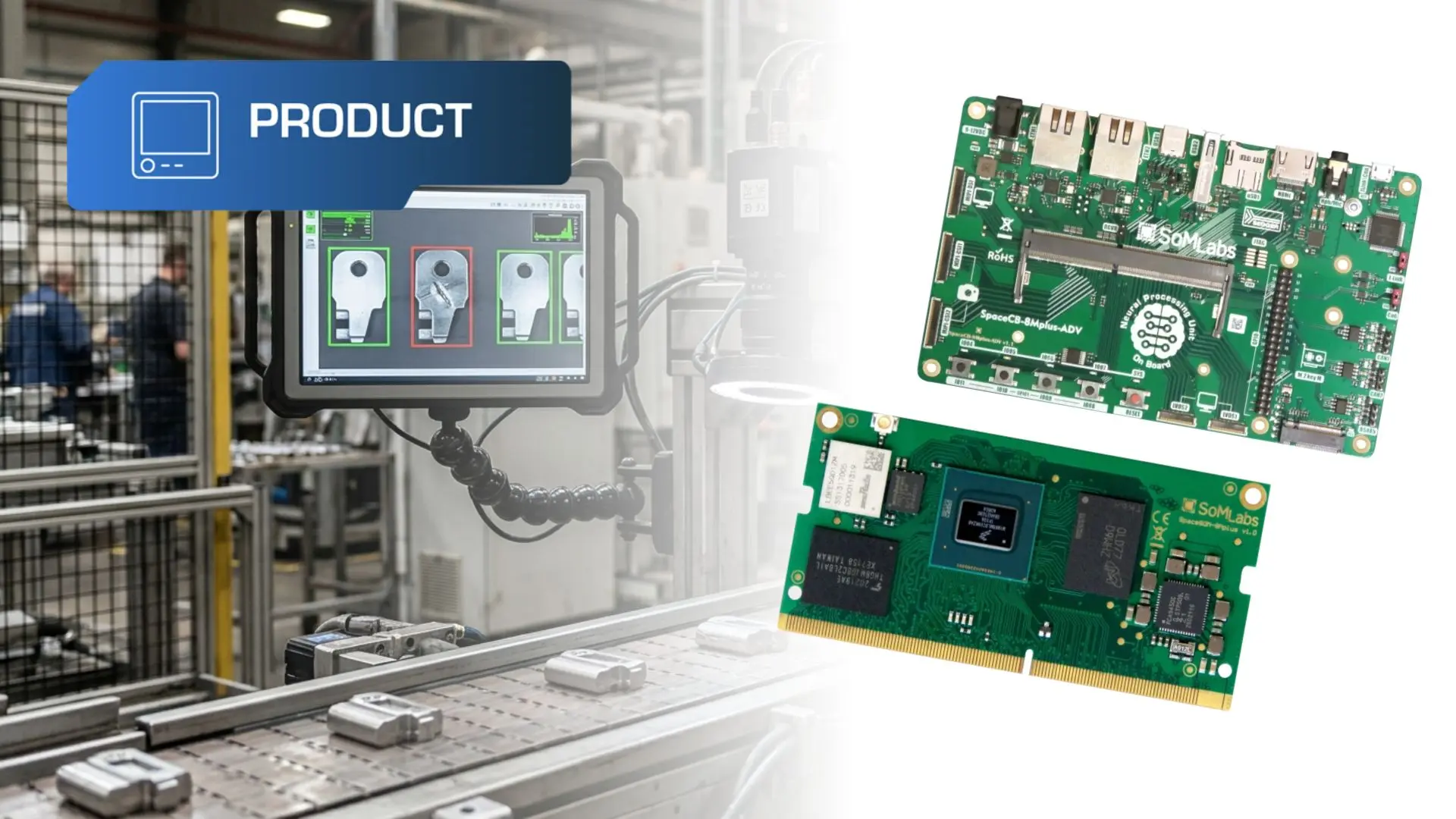
The growth of the Internet of Things, robotics, and artificial intelligence is driving designers to seek hardware platforms that are flexible, energy-efficient, and powerful. Such solutions make it easier to move from concept to testing and integration, while also helping to organize the architecture of the device being developed. This is one of SoMLabs areas of expertise, a Polish company that manufactures, among other products, System-on-Module (SoM) modules and carrier boards (CB) for embedded applications. Unisystem offers a range of such solutions, including SpaceSOM-8Mplus (SoM) and SpaceCB-8Mplus-ADV (CB). These are two complementary elements of one platform that can serve as a basis for advanced industrial systems.
SpaceSOM-8Mplus SLS35 – compute module
The SpaceSOM-8Mplus family from SoMLabs includes highly integrated SoM modules in the SODIMM260 form factor, designed to serve as the central element of a hardware platform. These modules are well-suited for applications that require high computing performance, image analysis, graphical user interface, and multimedia support, as well as local execution of AI and machine learning algorithms.
A key feature of the family is configuration flexibility. The available variants differ, among other parameters, in LPDDR4 and eMMC memory capacity, as well as in the availability of optional Wi-Fi and Bluetooth connectivity, allowing the module to be matched to the requirements of a specific project.
SODIMM260 form factor and integration with a base/carrier board
SpaceSOM-8Mplus modules are built in the SODIMM260 form factor, making their integration with a baseboard or carrier board easier. The connector provides both mechanical mounting of the module and electrical access to key processor, memory, and communication interface signals. As a result, the SoM can act as a complete compute unit that can be integrated with custom application electronics without the need to design the most complex part of the system from scratch.
Processor and AI capabilities
At the heart of the SpaceSOM-8Mplus modules is the NXP i.MX 8M Plus processor, which combines several specialized computing units responsible for different types of tasks. Cortex-A53 cores handle the operating system and user applications, while the Cortex-M7 core runs real-time tasks that require fast, predictable responses. The integrated NPU accelerates local AI and machine learning algorithms, the GPU supports graphics processing, and the VPU supports Full HD video processing.
Memory
The SpaceSOM-8Mplus family includes variants with LPDDR4 memory from 1 GB to 8 GB and eMMC storage from 4 GB to 32 GB. The availability of a specific configuration depends on the selected module, allowing the version to be matched to both simpler embedded applications and more advanced systems requiring greater memory resources.
Communication, multimedia, and wireless interfaces
The platform offers a wide range of interfaces, including USB 2.0/3.0, Ethernet, PCIe 3.0, CAN-FD, and I²C, SPI, and UART buses. This enables integration with peripheral devices, mass storage, and industrial automation components. The modules also support HDMI, LVDS, MIPI-DSI, and two MIPI-CSI channels, making it easier to connect displays and cameras. In selected configurations, the modules also offer Wi-Fi and Bluetooth connectivity, reducing the need for additional wireless communication circuits on the carrier board in many projects.
Linux and Android systems for high-level applications
SpaceSOM-8Mplus can run Linux and Android, enabling it for applications that require an advanced software environment, network communication, graphical interface support, and multimedia handling. These capabilities make the module well-suited, among other uses, for HMI solutions.
Operating temperature range
The SpaceSOM-8Mplus family has been developed for operation in varied environmental conditions. The availability of Consumer, Extended, and Industrial variants allows the module to be selected based on the requirements of a specific application. Depending on the version, the modules support operating temperature ranges of 0°C to +70°C, -30°C to +85°C, or -40°C to +85°C. This allows them to be used in both applications operating under controlled conditions and devices intended for more demanding environments, where resistance to low or elevated temperatures is important.
The table below summarizes the key parameters of the SpaceSOM-8Mplus family from SoMLabs. Please note that the values shown cover possible configurations within the product family, and their availability depends on the specific module variant.
| Parameter | SpaceSOM-8Mplus |
| Product type | SoM (System-on-Module), SODIMM260 form factor |
| Processor | NXP i.MX 8M Plus |
| CPU architecture | 4 × ARM Cortex-A53 + 1 × ARM Cortex-M7 |
| Number of cores | 4 application cores + 1 real-time core |
| Max. CPU clock speed | From 1.6 GHz to 1.8 GHz, depending on the variant |
| NPU | Up to 2.3 TOPS |
| RAM | From 1 GB to 8 GB LPDDR4, depending on the variant |
| eMMC memory | From 4 GB to 32 GB, depending on the variant |
| Graphics and video | Vivante GC7000UL/GC520 GPU, 1080p60 VPU |
| Interfaces | 2 × USB 2.0/3.0, 2 × Gigabit Ethernet, PCIe 3.0, 2 × CAN-FD, up to 6 × I2C, up to 3 × SPI, up to 4 × UART, HDMI, LVDS, MIPI-DSI, 2 × MIPI-CSI, SAI/PDM, optional Wi-Fi 802.11a/b/g/n/ac and Bluetooth 5.1 |
| System support | Linux, Android, FreeRTOS |
| Operating temperature | Depending on the variant: Commercial 0 to +70°C, Extended -30 to +85°C, Industrial -40 to +85°C |
| Supply voltage | 5 V DC |
| Module dimensions | 69.6 × 35 × 3.7 mm |
CRA ready and cybersecurity
It is also worth noting that the SpaceSOM-8Mplus product family has been described by SoMLabs as “CRA ready”, meaning that it is prepared with the requirements of the EU Cyber Resilience Act in mind.
The Cyber Resilience Act establishes common cybersecurity requirements for digital products throughout their lifecycle. In practice, this means that modules from the SpaceSOM-8Mplus family can be considered for projects in which not only computing and integration parameters matter, but also device security.
SpaceCB-8Mplus-ADV – integration platform
SpaceCB-8Mplus-ADV is a carrier board designed for SpaceSOM-8Mplus modules. It enables designers to quickly build a complete development platform for testing, integration, and further project development.
SpaceCB-8Mplus-ADV brings together a wide range of interfaces on a single board, including HDMI, LVDS, MIPI-DSI, MIPI-CSI, USB, USB-C, two Gigabit Ethernet ports, an M.2 Key M connector with PCIe, CAN-FD, and RS-485. This enables simultaneous support for displays, cameras, network communication, mass storage, and peripheral devices without the need for multiple additional expansion modules.
SpaceCB-8Mplus-ADV also includes an integrated Segger J-Link debugger and a Linux serial console available via USB vCOM. This facilitates software bring-up, system monitoring, message analysis, and error diagnosis already at the prototyping stage. Additional buttons and LEDs allow checking the platform’s basic functions, indicating system status, and performing simple tests without connecting external auxiliary circuits. As a result, the board can serve as a convenient base for building and verifying devices based on SpaceSOM-8Mplus modules.
The table below summarizes the key parameters of the SpaceCB-8Mplus-ADV carrier board:
| Parameter | SpaceCB-8Mplus-ADV |
| Product type | Carrier board for the SpaceSOM-8Mplus family |
| SoM connector | SODIMM260 |
| Supported SoM type | SpaceSOM-8Mplus modules |
| Expansion connectors | M.2 Key M with PCIe, GPIO, MicroSD |
| Memory | Uses the module’s memory |
| Communication interfaces and connectors | 2 × Gigabit Ethernet, USB, USB-C, CAN-FD, RS-485, HDMI, 2 × LVDS, MIPI-DSI, MIPI-CSI |
| User-accessible elements | Buttons, LEDs |
| Power supply | 9–12 V DC |
| Operating temperature range | 0°C to +70°C |
| Dimensions | 160 × 100 × 25 mm |
SoM and CB set – complementary elements of a single hardware platform
SpaceSOM-8Mplus and SpaceCB-8Mplus-ADV can be used independently, but they have been designed to work best together as a complete set. The SoM module provides the computing layer – including the processor, memory and AI functions – while the carrier board provides access to interfaces and simplifies integration of the entire system.
This combination enables rapid bring-up of a complete evaluation platform, without the need to design custom electronics at the early stage of development. At the same time, it supports further design flexibility – the same module can be used with another baseboard or integrated with a dedicated carrier board developed for a specific application.
In practice, this gives designers a convenient starting point for working on a system that can be developed and adapted to application requirements, without changing the key component: the compute module.
Example applications
The SpaceSOM-8Mplus and SpaceCB-8Mplus-ADV set can be used in many types of embedded systems – especially where performance, flexibility, and easy integration are important, including:
- industrial automation – production line controllers, data acquisition nodes, HMI panels,
- image-based quality control – object recognition systems, automated image analysis solutions, and cameras with local image processing,
- robotics and cobots – control units for collaborative robots, mobile AGV robots,
- IoT and telemetry – IoT gateways, urban infrastructure sensors, and environmental monitoring stations,
- local AI-based data analysis (edge AI) – systems for processing image, audio, and signal data directly in the end device.
The combination of the SpaceSOM-8Mplus module and the SpaceCB-8Mplus-ADV carrier board from SoMLabs is an example of a modern approach to embedded system design based on a ready-made hardware platform. Instead of building the solution from scratch, designers can rely on proven components and focus on what matters most – the functionality of the final device.
Looking for an embedded platform matched to your application? Contact us – we will help you choose the solution that best fits your project.