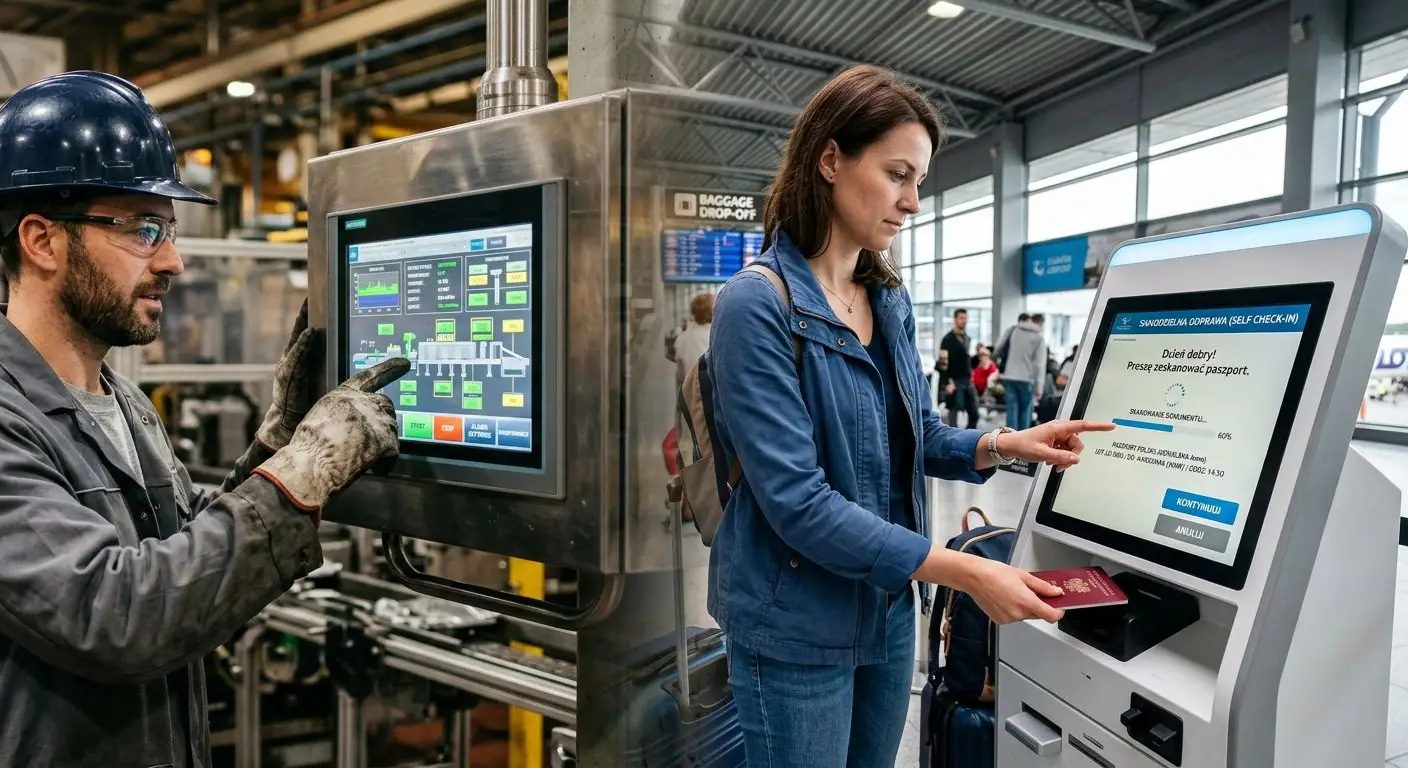
IPS (In-Plane Switching) is one of the most common LCD technologies, developed to improve color reproduction and viewing angles compared to traditional TN panels. In IPS, liquid crystals align parallel to the screen surface, enabling more uniform light control and producing richer colors, more accurate reproduction, and wide viewing angles – up to 178° horizontally and vertically. IPS is used wherever high image quality and comfort are critical, including industrial displays, medical devices, graphic monitors, smartphones, tablets, and laptops.
How does an IPS panel work?
In an IPS (In-Plane Switching) cell both electrodes lie on the same glass substrate. When voltage is applied, the electric field runs parallel to the glass and the liquid crystal molecules rotate within that plane instead of tilting towards the viewer, as they do in a TN panel. Because the molecules stay parallel to the screen, the light passing through changes much less with the viewing direction – colors and contrast stay stable even when the display is seen from the side.
IPS is a liquid crystal mode, not a separate type of display: an IPS display is still an LCD-TFT with a thin-film transistor behind every subpixel. Manufacturers also market IPS-type technologies under their own names, such as AAS, AHVA or FFS.
IPS vs TN vs VA
| IPS | TN | VA | |
|---|---|---|---|
| Viewing angles | Wide, typically up to 170–178° | Narrow, with a preferred viewing direction | Wide |
| Color and grayscale stability | Very good, no grayscale inversion | Color shift and inversion off-axis | Good |
| Native contrast | Typically around 1000:1 | Typically 500–1000:1 | High, often 3000:1 or more |
| Cost | Medium | Low | Medium |
| Typical use | HMIs, medical, multi-viewer displays | Cost-sensitive, fixed-position devices | Signage, high-contrast monitors |
When is IPS the right choice?
IPS is the default when a display may be viewed from several positions or when colors must look the same across the whole screen – operator panels mounted at different heights, medical monitors read by several people or handheld devices that are rotated. For fixed-position, cost-sensitive devices a TN panel with the correct viewing direction can still be sufficient.
IPS panels usually transmit a little less light than TN panels, so they need a stronger backlight to reach the same brightness. This matters in battery-powered and sunlight-readable designs.