
Article summary generated by AI — it may contain errors.
Table of contents
Displays are used across a wide range of modern military and defence equipment, including portable systems, operator panels, communication terminals, in-vehicle, airborne, and marine systems, as well as command-and-control stations. In these applications, the screen is responsible not only for presenting information but also for providing access to critical system functions.
Requirements for military operator panels are rarely limited to the display panel itself. The entire assembly must be considered, including the display, touch panel, protective glass, backlight, control electronics, connectors, seals, enclosure, and the method used to integrate the solution into the end device. The complete system must remain readable, stable, and predictable under the conditions in which the equipment will actually be used.
However, there is no single universal standard that defines a “military display”. The applicable requirements should be determined by the specific application, platform, operating environment, and program specifications. Standards and standardisation documents provide an important point of reference, but they cannot replace a thorough analysis of the intended use or the appropriate selection of test methods.
The US and NATO Frameworks – How Should They Be Applied?
Projects for the military and defence sector generally refer to two main standardisation frameworks: the US system, based partly on MIL-STD standards, and the NATO system, based partly on STANAG documents and the associated AECTP publications.
The following documents may be particularly relevant to display applications:
- MIL-STD-810 – a standard that sets out an approach to environmental engineering and environmental testing methods. It is not a universal checklist of pass/fail tests or a ready-made design specification. In practice, test methods and severity levels must be tailored to the product’s life cycle and the conditions under which it will operate.
- MIL-STD-461 – a standard covering the control of electromagnetic emissions and susceptibility characteristics of subsystems and equipment. Care should be taken not to apply it automatically to individual modules installed inside electronic enclosures or to entire platforms. MIL-STD-464 is a more appropriate reference for electromagnetic requirements at the system or platform level.
- MIL-STD-464 – a standard covering electromagnetic environmental effects, or E3, at the system and platform level, including airborne, maritime, ground-based, and space systems.
- MIL-STD-1472 – a human engineering standard concerned with adapting systems to the capabilities and limitations of their users. For display applications, it may be relevant to interface design, operating ergonomics, and the way information is presented to the operator.
- MIL-STD-3009 – a standard relevant to applications in which a display must be compatible with night vision imaging systems (NVIS). For displays, it specifies, among other requirements, strict limits on infrared emissions to prevent the screen from interfering with the operation of night-vision goggles.
- STANAG 4370 and the relevant AECTP publications – the NATO framework for assessing the resistance of defence equipment to environmental and mechanical conditions and, in the relevant publications, to electromagnetic effects.
The US and NATO systems are not directly equivalent on a one-to-one basis. It is more appropriate to regard them as separate standardisation frameworks that may address similar areas of requirements but have their own structures, scopes, and methods of application. In practice, it is important not only to identify the relevant document, but also to specify the level at which it is to be applied: the component, display assembly, device, system, or entire platform.
Which Areas of Requirements Are Most Important for Displays?
For displays used in military and defence applications, five areas are typically considered:
- readability and optical performance,
- compatibility with night vision imaging systems (NVIS),
- environmental resistance,
- mechanical resistance,
- electromagnetic compatibility (EMC).
This approach makes it possible to consider the display not as an isolated component, but as part of a larger module or device. What matters is not only the quality of the information presented, but also resistance to operating conditions, structural stability, reliable performance in the presence of other electronic systems and suitability for specific use scenarios, such as operation with night vision equipment.
Each of these areas may be governed by different standards, programme requirements or established engineering practices. When designing a display solution, it is therefore important to distinguish between three levels: the standard as a reference document, the programme requirement as a specific criterion for a given project, and the technical solution used to meet that requirement.
Readability: Brightness, Contrast, and Reflection Control
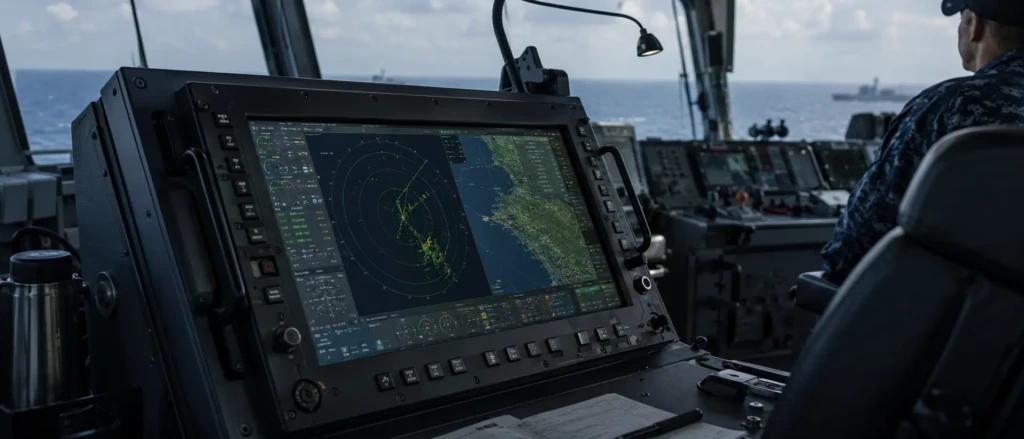
In military applications, display readability must be maintained across a wide range of lighting conditions, both indoors and outdoors, as well as in intermediate environments such as vehicle cabins, operator shelters, and enclosed platforms. This requirement applies not only to the display panel’s parameters, but also to the entire optical design of the module.
In practice, readability is assessed using a combination of parameters, including brightness, contrast, glare, surface reflectance, viewing angles, backlight uniformity, and image stability under the intended operating conditions. High brightness alone does not guarantee optimal visibility in strong ambient light. Even a high-brightness display may be difficult to read if the front assembly produces significant reflections or if external light reduces the effective image contrast.
For this reason, solutions intended for use in daylight employ not only higher-brightness panels, but also measures such as anti-glare (AG) and anti-reflective (AR) coatings. Optical bonding involves permanently joining the display to the touch panel and/or protective glass using a transparent optical adhesive. This eliminates or significantly reduces the air gap between layers, limits internal reflections, and improves the perceived contrast for the user.
Military projects must also account for the stability of backlight performance across the full operating temperature range, the effect of module heating on optical characteristics, and the durability of optical components throughout an extended service life.
The HMI design itself is equally important. Character size, the contrast of graphical elements, information hierarchy, colour scheme, message placement, and the way alarms are presented may determine whether the operator can interpret the information quickly and unambiguously under stress, time pressure, or changing lighting conditions.
Compatibility with Night Vision Imaging Systems (NVIS)
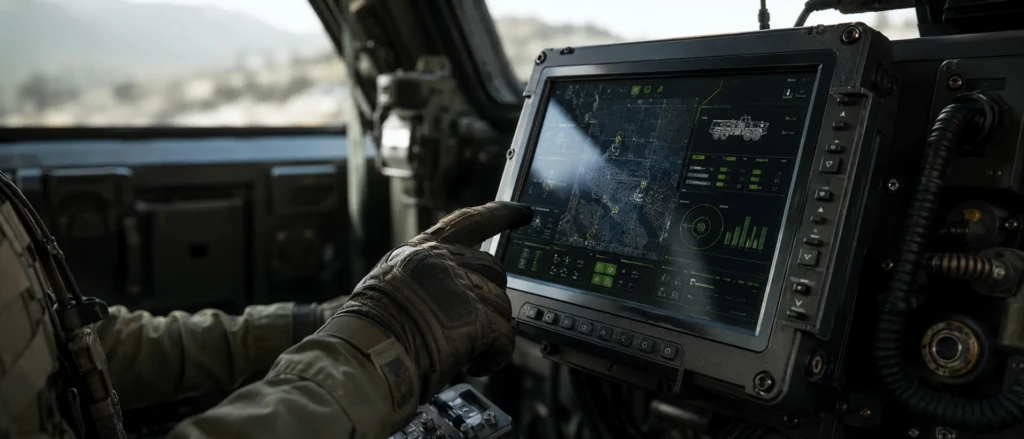
A separate set of optical requirements applies to applications in which the display is intended to operate alongside night vision imaging systems. In such cases, it is important not only that the image remains readable to the operator, but also that the screen does not interfere with the operation of night vision goggles.
Excessive or improperly controlled light emissions, particularly in the near-infrared range, can saturate the NVIS, reduce image contrast through the goggles, or impair the operator’s ability to observe the surroundings. NVIS compatibility should therefore not be regarded as a standard feature of every military display, but rather as a scenario-specific requirement for equipment that will actually be used with night vision systems.
Meeting these requirements may involve the use of a dedicated backlight, optical filters, spectral emission control, an appropriate brightness adjustment range, and carefully selected interface colours. As each of these elements affects the final optical emissions, NVIS compatibility should be verified at the level of the complete device or fully assembled display front.
Environmental Resistance
Environmental resistance is one of the most important areas of requirements for military and defence equipment. Within the US framework, the primary reference is MIL-STD-810, while the NATO framework is based on STANAG 4370 and the relevant AECTP publications.
MIL-STD-810 should not be presented as a standard that imposes a single mandatory set of tests on every device. It defines an environmental engineering process based on tailoring and provides environmental test methods selected according to the anticipated life cycle of the product. In practice, this means identifying which environmental conditions are genuinely relevant to a particular project, such as temperature, humidity, precipitation, dust, sand, salt exposure, solar radiation, vibration, or shock. For displays, the key issue is not only whether the module survives a given exposure, but also whether it retains its intended functionality, including image readability, electronic stability, correct backlight operation, touch-panel response, and predictable interface behaviour.
Ambient temperature can significantly affect the operation of a display module. Low temperatures may affect, among other factors, liquid-crystal response time, electronic stability, and overall image readability. Under such conditions, it is important to select a panel with an appropriate operating temperature range. Some applications may also require heating elements and temperature control within the module. High temperatures affect not only the service life of the panel itself but also the backlight, the stability of optical parameters, and the effective heat dissipation. In practice, this may require careful placement of the electronics, the use of thermally conductive materials, heat sinks, or other design measures that support thermal management.
Protection against water, dust, sand, and other contaminants requires careful design of the device front and of all points through which contaminants could enter the enclosure. For a display assembly, particular attention should be paid to the protective glass, optical bonding, seals, frame design, protection of connectors and signal cables, and the method used to mount the module in the end device.
Mechanical Resistance: Vibration, Shock, and Structural Stability
Environmental requirements may also cover mechanical loads, including vibration, shock, and stresses encountered during transport. For displays, these factors are particularly important in vehicle-mounted systems, portable equipment, operator panels, and field-use devices.
The mechanical resistance of a display module depends on more than the panel itself. Key considerations include how the display is mounted, how the individual layers are supported, the strength of the protective glass, the integrity of the connections, the retention of connectors, and the reduction of mechanical stresses between the module’s components.
In military applications, the display must remain stable under vibration and shock while preserving image readability and reliable touch-panel operation. The module design must therefore account for the specifications of the individual components and the mechanical construction of the complete solution.
EMC and EMI – Electromagnetic Compatibility and Interference
Another important area is electromagnetic compatibility, or EMC. This refers to a device’s ability to operate correctly within a specified electromagnetic environment without interfering with other equipment or being excessively susceptible to external disturbances. Closely related to EMC is electromagnetic interference, or EMI, which may be generated by the device itself or originate from external sources. In display applications, EMI control involves both limiting emissions from the module and ensuring adequate immunity to interference in its operating environment.
This is particularly important for display systems because a display module is not solely an optical component. It also includes control electronics, an LED backlight, power converters, power supply circuits, communication interfaces, cables, connectors, and, in many cases, a touch-panel controller. These elements may generate electromagnetic interference and be susceptible to disturbances from nearby components or systems.
In military and defence equipment, electromagnetic interference can affect communication, navigation, sensors, radar, control systems, and other electronic equipment operating within the same platform. The complete display assembly should therefore be designed to minimise electromagnetic emissions while maintaining stable operation in the presence of external interference. This requires effective shielding, appropriate grounding, protection of signal and power lines, suitable filtering, careful control of power-converter operation, and well-planned integration of the electronics with the device’s mechanical structure.
In solutions that incorporate a touch panel, the touch controller’s immunity to electromagnetic interference is also important. Disturbances can affect capacitive sensing stability, causing false detections, ghost touches, delayed responses, or temporary loss of touch accuracy. When designing a touch-enabled module, it is therefore important to select a controller with suitable interference-filtering and compensation mechanisms and to ensure that the entire touch-sensing system is integrated correctly.
It is important to emphasise that EMC test results depend on the complete device configuration. Even when individual components meet the specified requirements, the final assembly may behave differently once integrated with the enclosure, cabling, power supply, control computer, and other elements of the system.
Why Must Standards Be Applied at the Correct Integration Level?
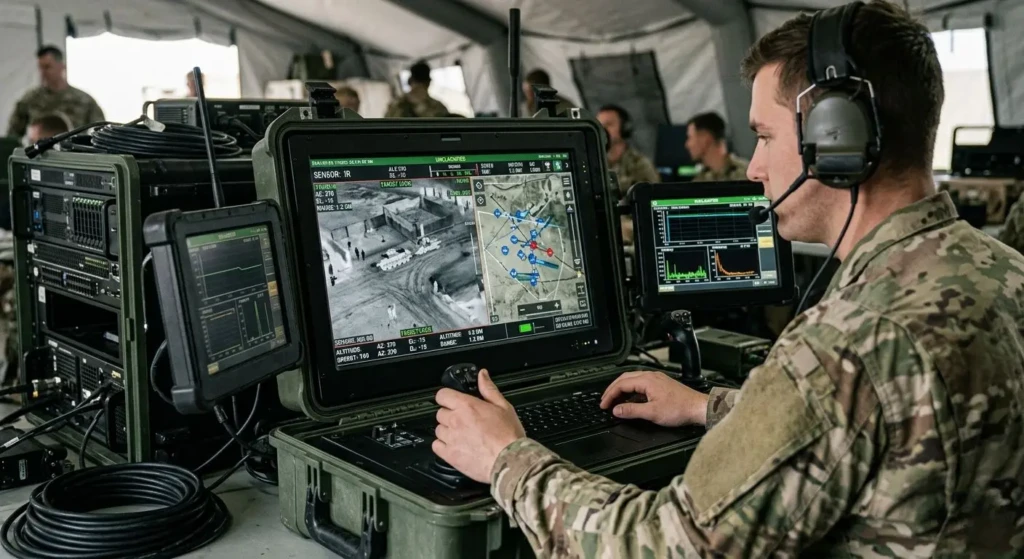
For displays used in military and defence applications, a key consideration is that standards rarely apply to the display panel alone. Depending on the scope of the relevant document and the programme requirements, the subject of assessment is usually the finished module, complete device, subsystem, or entire platform.
Compliance, therefore, depends not only on selecting the right display but also on its integration. Relevant factors include the touch panel, protective glass, optical bonding, surface coatings, electronics, connectors, cabling, seals, enclosure design, thermal management, and electromagnetic shielding.
For this reason, the development of a display solution for a military or defence application should begin with defining the requirements that apply to the intended use. Only then can the appropriate components be selected.
Looking for the right display for a military application? Contact us. Together, we will select a solution tailored to the technical, environmental, and standards-related requirements of your project.