Article summary generated by AI — it may contain errors.
Table of contents
In the design and integration of modern visualization systems – both stationary and mobile – it is essential not only to match the format or interface but also to thoroughly analyze the display’s operating parameters. The screen refresh rate is one of the key criteria that influences image smoothness, interface responsiveness, and overall system efficiency.
In this article, we explain what a screen refresh rate is, how it works across different display types, and why it is worth considering this parameter when selecting screens for professional applications.
Screen refresh rate – what is it?
The screen refresh rate is one of the fundamental technical parameters of a display that affects the quality and smoothness of the presented image. It defines how many times per second the screen updates the displayed content – this value is expressed in hertz (Hz). In practice, this means that a panel operating at 60 Hz refreshes the image 60 times per second, while a 120 Hz model does so twice as often. The higher the refresh rate, the smoother the motion representation and the better the readability of dynamic content. However, it is important to distinguish refresh rate (expressed in Hz) from matrix response time (expressed in ms), which defines how quickly individual pixels change their state. Although these parameters are separate, together they influence image quality during motion.
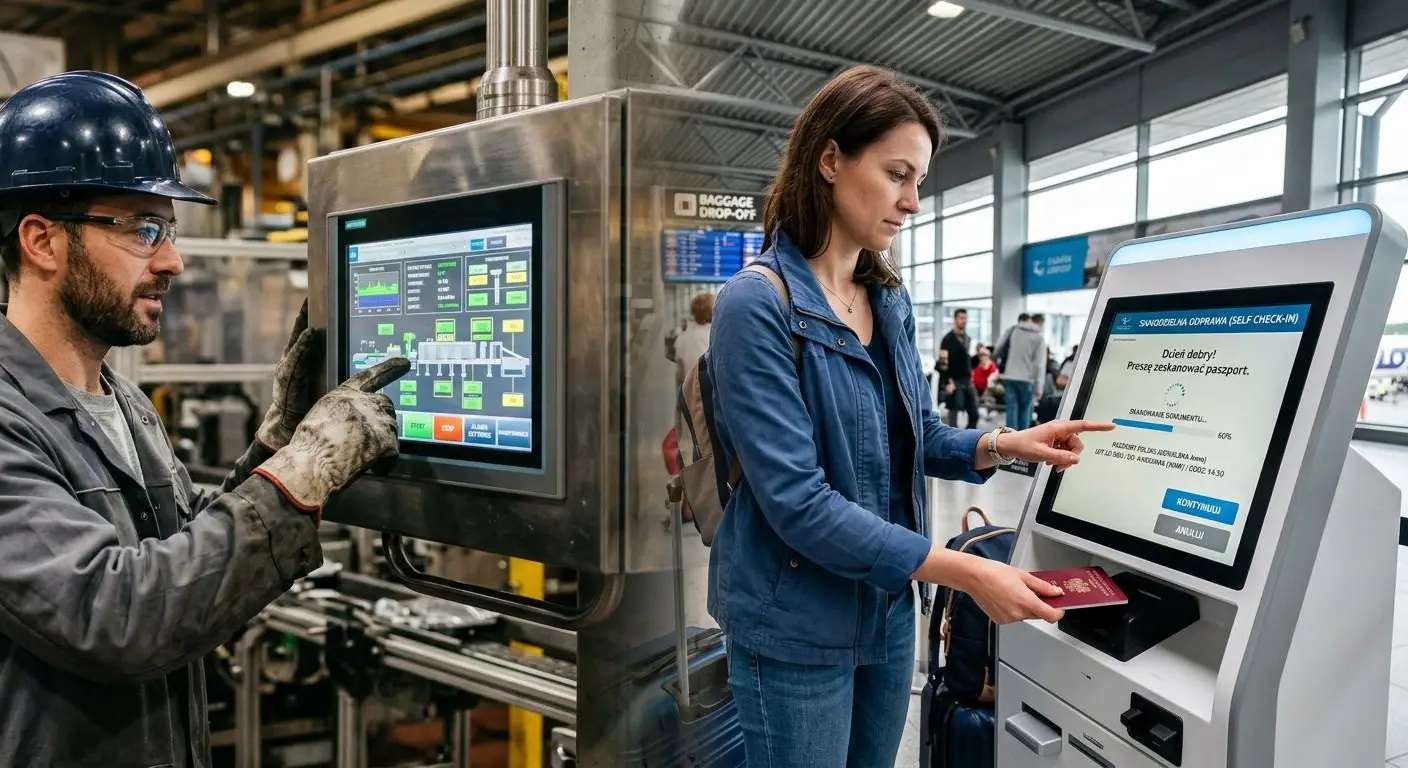
Although this parameter is often associated with the consumer sector (e.g., TV screens or gaming monitors), its importance is equally significant in professional, commercial, and industrial applications. In areas such as manufacturing, automation, logistics, or medicine, the screen refresh rate directly affects operator precision, touchscreen interface smoothness, and the speed of presenting dynamically changing data.
How does the screen refresh rate work in different types of displays?
As mentioned earlier, the screen refresh rate defines how many times per second the image is updated, and the way it affects system performance depends on the type and intended use of the display.
For displays and monitors used in HMI interfaces, SCADA systems, or operator stations, the typical refresh rate ranges from 60–75 Hz, providing appropriate data presentation smoothness and stable performance.
Similar benefits can be observed in mobile devices used in professional environments. High image quality and fast screen response time translate into smooth interface operation and user comfort, which is important, for example, in portable diagnostic devices.
Variable refresh rate – how does it work and what benefits does it offer?
Variable Refresh Rate (VRR) is a technology that dynamically adjusts the refresh rate to the number of frames generated by the signal source. This may be a computer, a graphics controller, or another system transmitting visual data. VRR helps reduce image-disrupting phenomena such as tearing, latency, or micro-stuttering, significantly improving operational smoothness and visual comfort.
In professional applications, image stability is crucial – not only for the readability of displayed content but also for interface responsiveness.
Technologies such as FreeSync (AMD), G-Sync (NVIDIA), or Adaptive Sync (DisplayPort standard) allow even better synchronization between the display and the signal source – also in screens used in HMI solutions, including SCADA systems, remote monitoring, or process control. Thanks to VRR, it is possible to maintain smooth image output even when the number of generated frames per second (FPS) changes dynamically.
Refresh rate and touch monitors in industrial applications
In industrial applications – such as automation, logistics, transport, or medicine – fast and reliable touchscreen operation is essential. A high refresh rate (e.g., 75 Hz or higher) significantly improves panel responsiveness, reduces system reaction time to touch, and increases operator comfort.
LCD-TFT displays with high brightness and contrast, combined with a high refresh rate, ensure excellent image readability even in intense lighting conditions. Bright and saturated colors, adjustable backlight, and fast refresh minimize glare and eye strain, which in a work environment translates to longer concentration and reduced risk of errors.
A high refresh rate in LCD-TFT displays also supports HMI interface ergonomics, improving image smoothness and shortening system reaction time, which directly impacts process efficiency and the stability of information visualization systems, even in demanding industrial conditions.
The future of display refresh technologies – what’s next?
LED technology has long been the foundation of modern display development. Thanks to its energy efficiency, high brightness, and broad integration capabilities with different types of matrices, LED has become the basis for many advanced applications, including professional solutions.
Modern visualization technologies are evolving towards higher image quality, greater performance, and increased durability. Among the key solutions, the following stand out in particular:
- OLED – a technology offering nearly instantaneous pixel response time and excellent contrast (true black), which is particularly important in precise medical applications and quality control systems,
- mini-LED – a solution providing high brightness and uniform backlighting, significantly improving working comfort in variable lighting conditions,
- microLED – a technology combining the advantages of OLED and LED, delivering high durability, great scalability, and very fast response times, which are crucial in industrial applications.
In practice, this means the possibility of designing even more responsive, reliable, and energy-efficient information display systems. Furthermore, the development of imaging industry standards – such as HDMI 2.1 or DisplayPort 2.0 – enables handling increasingly higher refresh rates without signal quality loss.
High screen refresh rates in the coming years will become standard not only in consumer electronics but also in commercial and industrial systems, where precision, reliability, and smooth interpretation of information are essential. LED technologies – in all modern variants – will continue to play a key role in the development of intelligent, ergonomic visual interfaces.
To select the right display, it is worth starting with an evaluation of key parameters. In our guides, we explain which aspects are most important when choosing the optimal solution for your project.
- How to choose a display for your application? A guide by Unisystem – part 1: technological basics and types of displays,
- how to choose a display for your application? A guide by Unisystem – part 2: dimensions, formats, and device integration,
- how to choose a display for your application? A guide by Unisystem – part 3: operation, durability, additional features.