Table of contents
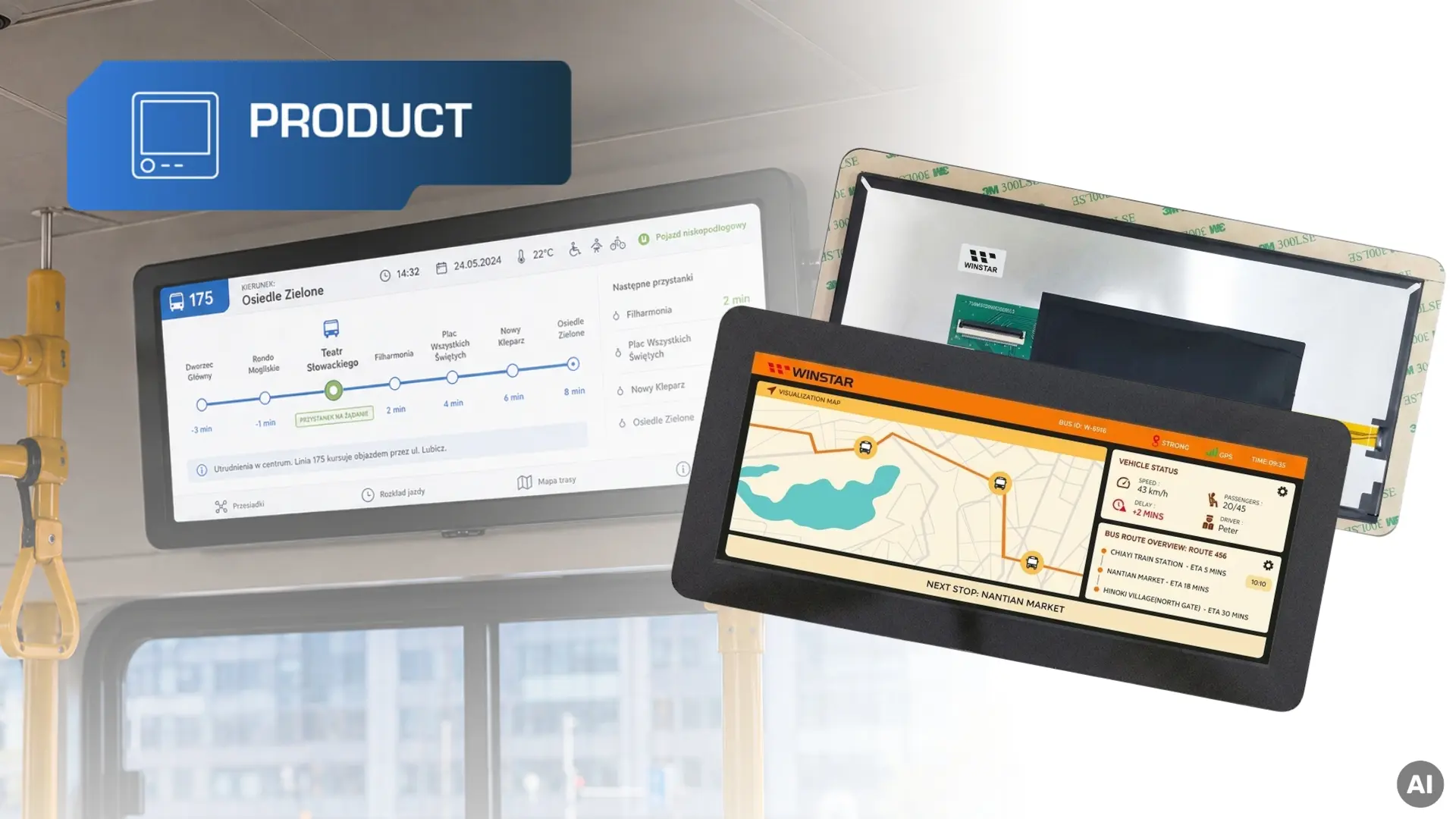
Some applications require information to be presented in a wide, horizontal layout, ensuring that related data remains continuous and easy to read within a single view. This applies, for example, to transport routes, consecutive stages of a process, parameters from several parts of a system, or complex control panels. Panoramic displays are well suited to these applications, as their elongated aspect ratio makes it easier to organize data and adapt the interface to the device’s design.
One example is Winstar’s WFN1025A2S0WALNA000 – a 10.25-inch LCD-TFT with a resolution of 1920 × 720 pixels. In this article, we examine its key specifications, the solutions used to improve image readability and ease of operation, and the options for integrating the module into industrial devices.
Panoramic format – integration into industrial systems
The active display area of the WFN1025A2S0WALNA000 measures 243.65 × 91.37 mm, while the complete module with the touch panel measures 277.5 × 127 × 12.95 mm. Its width-to-height ratio gives the screen its distinctive panoramic format, also known as bar type.
Thanks to their elongated proportions, panoramic displays make efficient use of spaces where vertical clearance is limited but greater width is available. They can be integrated into devices or, when fitted with a suitable enclosure, installed as standalone screens – for example, above doors or windows in vehicles, as well as above passageways and workstations in production facilities or warehouses.
This screen format is particularly well suited to interfaces that require a single, continuous horizontal view, such as route diagrams showing consecutive stops, process stages, workstation statuses, or parameters from several parts of a system. Information can be arranged side by side in a logical sequence, making it easier to interpret quickly while maintaining a consistent interface.
Resolution
The WFN1025A2S0WALNA000 has a resolution of 1920 × 720 pixels, which, combined with its 10.25-inch diagonal, provides a pixel density of approximately 200 ppi. At this density, individual pixels are less noticeable, allowing text, icons, charts, and fine lines to be rendered with sharp, well-defined edges. This is particularly important in interfaces containing numerous detailed elements, such as parameter labels, scales, diagrams, or small symbols.
Wide viewing angles
The model uses IPS technology, providing wide viewing angles of 85°/85°/85°/85° while minimising shifts in contrast and colour when the screen is viewed from different directions. This is especially important in applications where the screen is installed above or below eye level or viewed from different positions. As a result, the information remains legible without the user having to stand directly in front of the screen.
Brightness
The WFN1025A2S0WALNA000 offers a high brightness level of 800 cd/m², ensuring that the displayed content remains easy to read even in brightly lit indoor environments. This provides greater flexibility when installing the screen in locations where lighting conditions change throughout the day.
Touch panel
The model is integrated with a capacitive touch panel (PCAP) that can detect up to ten simultaneous touch points. This allows users to operate the interface using both single-touch input and multi-finger gestures, such as swiping, zooming, or rotating on-screen elements. These functions can be particularly useful when working with maps, diagrams, or charts.
Touch data is transmitted to the device’s control electronics via the I²C interface. The availability and operation of individual gestures also depend on the software and the design of the user interface.
Which touch technology is best suited to your project? Explore the key differences between capacitive and resistive touch panels in our guide: CTP vs. RTP – Key Differences Between Capacitive and Resistive Touchscreen Technologies.
Video interface and integration
The video signal is transmitted to the display via an LVDS interface. Its differential signalling method supports stable video transmission and reduces the signal’s susceptibility to electromagnetic interference. As the module does not include an integrated controller board, it must be connected to electronics equipped with a compatible LVDS output. The integration method should therefore be considered at the system electronics design stage.
Wide operating temperature range
The WFN1025A2S0WALNA000 can operate at temperatures ranging from –30°C to +85°C, making it suitable for applications exposed to both very low and high temperatures. These include vehicles, unheated production facilities and warehouses, as well as transport infrastructure, where operating conditions may vary considerably depending on the season, the surrounding environment, or heat generated by the device.
The key specifications of Winstar’s WFN1025A2S0WALNA000 are summarised in the table below.
| Parameter | WFN1025A2S0WALNA000 |
| Size | 10.25″ |
| Outline dimensions | 277.5 × 127 × 12.95 mm |
| Active area | 243.65 × 91.37 mm |
| Resolution | 1920 × 720 pixels |
| Panel technology | IPS |
| Viewing angles | 85°/85°/85°/85° |
| Brightness | 800 cd/m² |
| Touch panel | Capacitive (PCAP) |
| Touch panel interface | I²C |
| Video interface | LVDS |
| Operating temperature | –30°C to +85°C |
| LED backlight lifetime | 30,000 hours |
Typical applications for Winstar’s WFN1025A2S0WALNA000
The WFN1025A2S0WALNA000 can be used in solutions for a range of sectors, including:
- industrial automation – operator panels, control consoles, production line interfaces, process monitoring systems, measuring equipment, and quality control stations,
- logistics and warehousing – picking station terminals, sorting system panels, automated storage system interfaces, material flow management equipment, and product identification systems,
- transport – in-vehicle control panels, fleet management system interfaces, control consoles, and screens displaying status information and messages,
- passenger information systems – information panels, passenger service terminals, and systems presenting routes, messages, and operational data,
- building automation – building management panels, HVAC system controllers, and interfaces for monitoring and controlling lighting, energy use, and security systems,
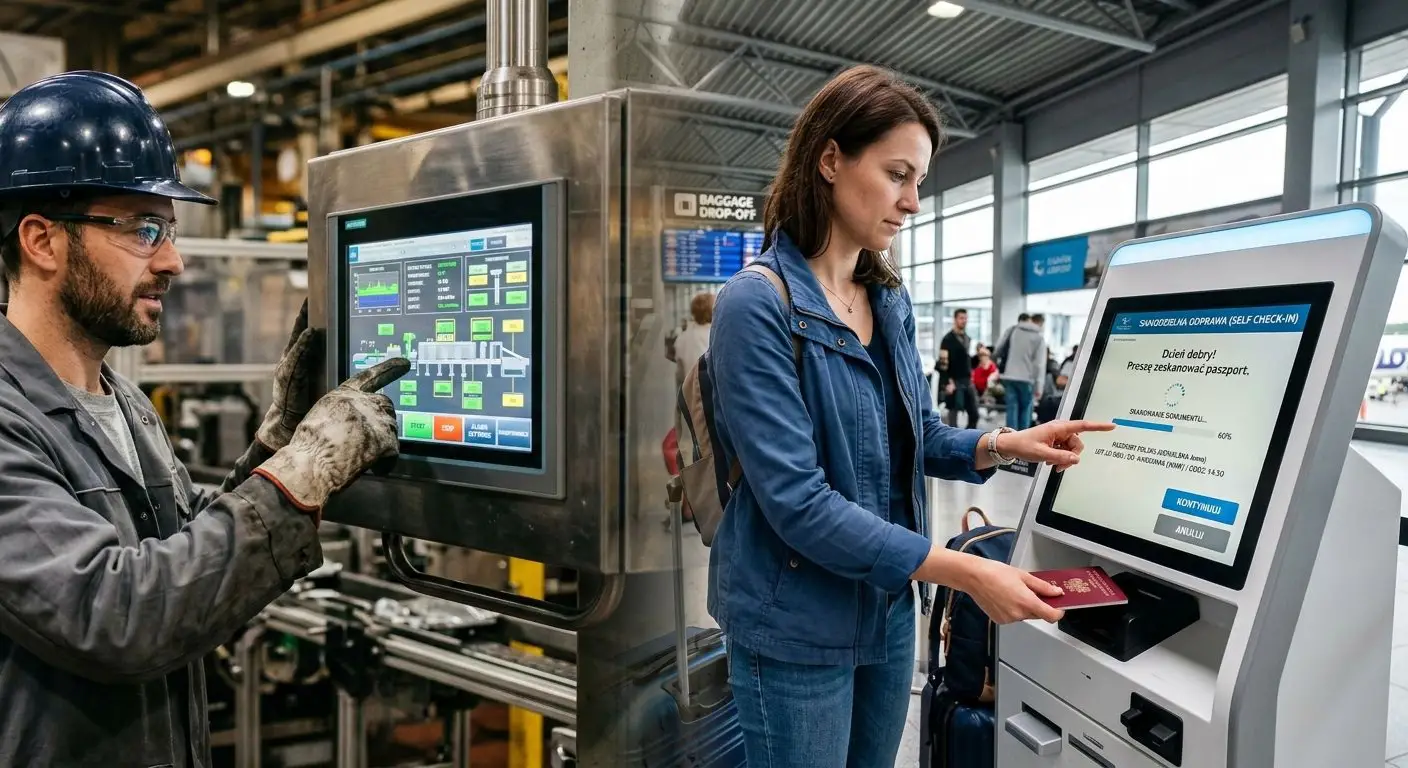
- retail and services – vending machines, self-service kiosks and terminals, point-of-sale system panels, and equipment used to process orders and payments,
- medical and laboratory equipment – analysers, diagnostic equipment, parameter monitoring stations, and equipment control panels.
The suitability of the module for a specific application should always be assessed against the environmental, mechanical, and electrical requirements, as well as the standards applicable to the device.
Not sure whether the WFN1025A2S0WALNA000 is suitable for your application? Contact us – we will help you select a solution tailored to your device design, operating conditions, and planned integration method.