Article summary generated by AI — it may contain errors.
Table of contents
Industrial displays often have to operate in conditions where standard electronics would fail. Contaminants, dust and moisture, and the necessity of maintaining rigorous hygiene standards – including, for example, regular washing with hot water at high pressure – are everyday occurrences in many industrial sectors. In such environments, the appropriate level of display protection is crucial, as it determines not only its durability but also user safety and the continuity of technological processes.
For this reason, the international IP protection classes, which define the degree of resistance of devices to external factors, play a special role. The highest of these is class IP69. In the remainder of this article, we explain what the IP69 protection rating means, why it is so important in the context of industrial displays, and in which applications it is most suitable.
IP69 in industrial displays – significance and applications
The IP (Ingress Protection) marking system was developed to clearly specify the degree to which devices are protected against external factors such as dust and water, and against accidental contact with components inside the enclosure. Each IP code consists of two digits that indicate the level of sealing in two separate categories: protection against the ingress of solid particles (the first digit) and protection against the ingress of water (the second digit) into the device.
In the case of the IP69 protection rating, the meaning of the individual digits is as follows:
- first digit (6) – denotes complete dust‑tightness, meaning full protection against the ingress of any solid particles, as well as protection for the user against contact with hazardous parts,
- second digit (9) – indicates the highest possible level of protection against water; the device is resistant to water jets at very high pressure (80–100 bar) and at high temperatures of up to +80 °C.
In practice, this means that IP69 is the highest available sealing rating. No other standard provides such effective protection in extremely demanding operating conditions.
For comparison, it is worth citing a few lower IP protection classes:
- IP20 – the standard for devices used indoors, such as offices or homes; it provides protection against finger contact and against solid objects with a diameter greater than 12.5 mm, but does not offer any protection against water or moisture,
- IP44 – a standard found in devices used in indoor environments exposed to dust or splashes, e.g. in kitchens and bathrooms; it provides protection against contact with hazardous parts with a wire, protection against the ingress of solid objects with a diameter greater than 1 mm and resistance to splashing water from any direction,
- IP65 – a popular class for applications with increased sealing requirements, such as control devices in production halls or equipment installed or used outdoors (lighting, monitoring systems, consumer electronics); it guarantees complete dust‑tightness and resistance to a jet of water poured onto the enclosure from any direction.
That is why the IP69 protection rating often has a key significance in the case of industrial displays. Only this sealing class provides full reliability for devices operating in the most demanding environments, where intensive cleaning, contamination, dust and water are an inseparable part of everyday use.
What tests are carried out to verify whether a device meets the requirements of the IP69 class?
The IP69 certificate is awarded only after a device has passed a series of demanding tests:
- dust‑tightness test (IP6X) – the device is placed in a chamber with fine dust and subjected to a negative pressure; not even a trace of dust may appear inside the enclosure,
- water‑resistance test (IPX9) – the device is sprayed with water at a temperature of up to +80 °C, at a pressure of 80–100 bar, for about 30 seconds from each side and at various angles; after the test, there must be no moisture inside the enclosure.
Only meeting both conditions gives the manufacturer the right to label the device with the IP69 class. This ensures that the user receives equipment that meets the highest sealing and external resistance standards.
IP69 and industrial displays
Displays used in industrial environments must operate reliably despite constant exposure to factors that would pose a serious threat to standard electronics. Dust and water, grease particles or regular surface cleaning can quickly lead to failures of devices with a low sealing class. Even temporary ingress of contaminants into the enclosure can result in downtime, costly repairs or the need to replace equipment. Therefore, choosing screens with the highest possible protection rating, such as IP69, makes it possible to significantly reduce the risk of failures, increase user safety and ensure the continuity of production processes.
Water‑resistance and high‑pressure resistance — what does it mean in practice?
The IP69 protection rating guarantees resistance of the device to direct exposure to a strong stream of hot water at a pressure of 80 to 100 bar and at a temperature of up to +80 °C. This is a level of protection that significantly exceeds typical hazards present in industrial plants – from accidental splashing with liquid (not only water but also, for example, oils or gels) to continuous operation in a humid or highly dusty environment. Devices that meet this standard can be treated like other elements of the production line intended for regular, intensive washing.
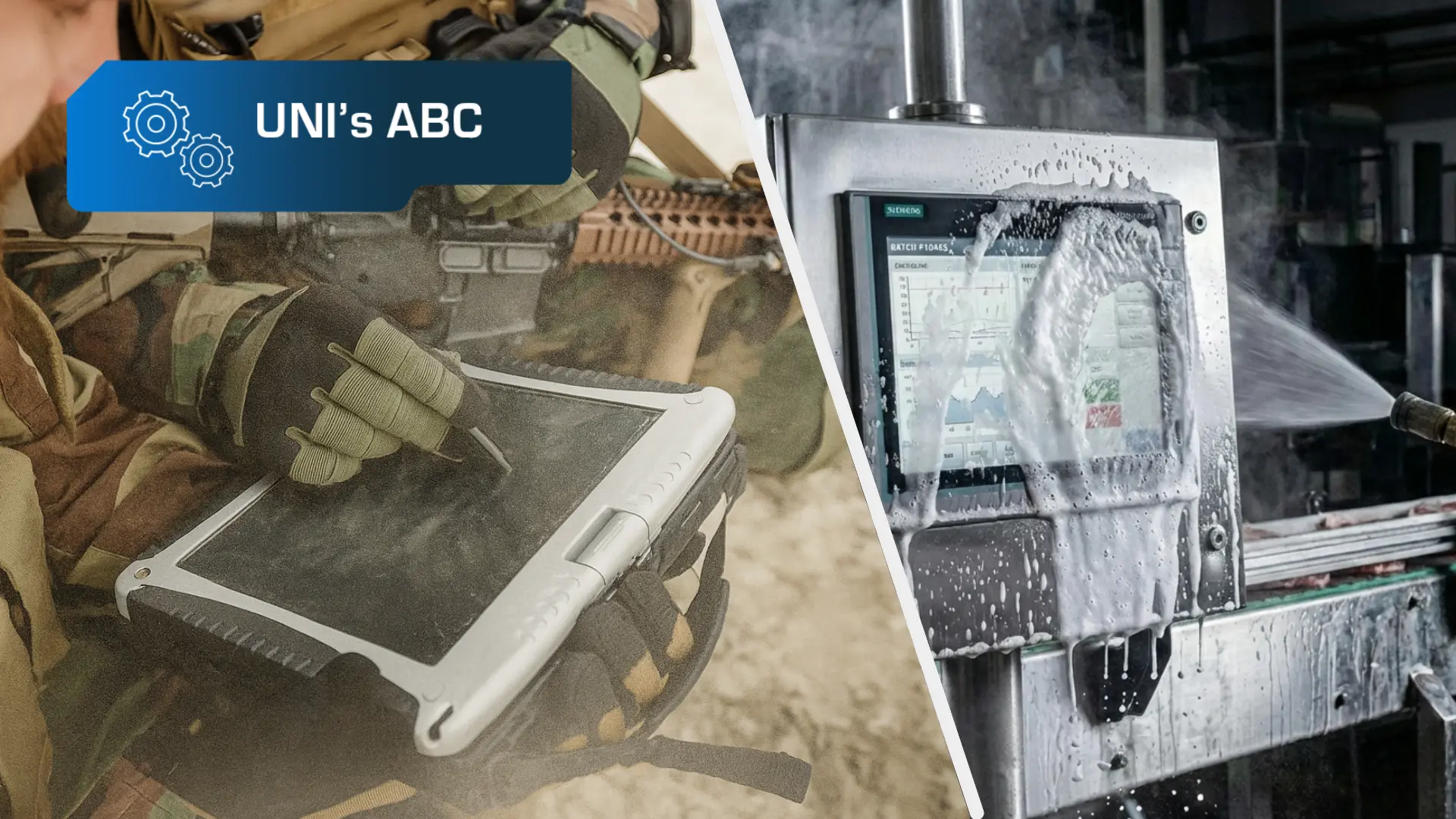
In practice, this means that displays with an IP69 protection rating can be safely cleaned using industrial pressure washers, without the need to dismantle them, cover them with foil or apply additional protection. Such high sealing effectively eliminates the risk of flooding electronic systems, which in the case of standard devices could lead to serious failures. This is particularly important in environments where maintaining cleanliness and hygiene and the speed of cleaning processes are as important as the reliable and continuous operation of the equipment.
Protecting industrial displays intended for operation in demanding environments
The IP protection rating determines the level of sealing of a device’s enclosure. In practice, however, increased durability and reliability of an industrial screen can be achieved independently of the enclosure itself by using solutions that protect individual elements of the display. Depending on the requirements of a given application, additional safeguards can be implemented, such as:
- protection of the display surface – using protective glass that increases resistance to mechanical damage and to chemicals used during intensive cleaning,
- joining screen components using the optical bonding method (optical bonding) – permanently bonding the display to the touch panel or protective glass using specialist adhesives, eliminating the air gap where dust or moisture could accumulate and adversely affect screen operation,
- sealing critical areas – such as the edges of the display, the areas where it meets the touch panel or protective glass, and the mounting elements,
- protection of electronics – for example through conformal coating of PCBs, which protects electronic systems against moisture, among other factors,
- increasing mechanical resistance – appropriate selection of materials and structures that protect the screen against vibrations, shocks and other loads characteristic of industrial environments.
Only the combination of a sealed enclosure with additional protection of the display itself makes it possible to obtain a solution fully adapted to long‑term operation in demanding industrial conditions.
Applications of industrial displays with the IP69 certificate
Displays with an IP69 protection rating are used wherever devices are exposed to exceptionally harsh environmental conditions. Typical areas of use include:
- food industry – production lines and equipment that require regular cleaning and disinfection,
- pharmaceutical industry – production and control systems operating in environments with stringent hygiene requirements, subjected to frequent cleaning and disinfection,
- chemical industry – installations and workstations exposed to corrosive substances, aggressive fumes and dust, as well as increased humidity,
- agriculture – machines and devices operated in the field which are intensively cleaned with high‑pressure water after work,
- construction – equipment and vehicles operating on construction sites, exposed to mud, dust and moisture, regularly washed using pressure washers,
- automotive – displays used in commercial and specialist vehicles operating in difficult off‑road conditions,
- military and defence – screens mounted in equipment and specialist vehicles where a high resistance to environmental factors is required.
In all these cases, investing in IP69 displays means lower risk of failure, longer service life of the devices and elimination of downtime costs caused by flooding or contamination of electronics.
IP69 is the highest possible protection class for industrial displays – indispensable wherever equipment is exposed to extreme operating conditions. If you would like to learn more about the lower sealing classes, take a look at our article containing a table that characterises the various protection ratings of enclosures.
Solution – share your challenge, we will deliver the solution
For years, Unisystem has specialised in customised projects carried out by the Solution team, which develops complete devices based on displays, integrating electronics, mechanics and software. The design process covers the entire implementation cycle – from concept and design through prototype creation, to environmental testing and deployment for production.
This approach makes it possible to create “tailor‑made” solutions, including devices with an increased sealing class, adapted to specific working conditions and environmental requirements. Thanks to the experience of the Solution team, it is possible to design enclosures that meet rigorous requirements, such as IP69, both for indoor and outdoor applications, ensuring reliability and long‑term operation even in the most demanding applications.
IP69 and enclosure sealing classes – frequently asked questions
In which industries is the IP69 protection rating most often required?
The IP69 protection rating is used in environments with particularly demanding operating conditions in which devices are regularly exposed, for example, to intensive washing at high pressure, often using hot water and detergents. This applies to industries such as the food and pharmaceutical industries, where cleanliness and hygiene requirements are paramount, the chemical industry – due to the presence of potentially harmful substances, and agriculture and construction, where equipment, devices and vehicles are regularly subjected to intensive cleaning.
What does the IP69 sealing class concern – the display or the entire device?
The IP69 sealing class refers to the complete device or module in a specific configuration. It covers not only the enclosure itself but also the way the display, protective glass, connectors, cable glands and mounting elements are sealed. The whole solution is always assessed, not just an individual component.
Does every industrial display meet the requirements of the IP69 class?
No. Achieving the IP69 class requires appropriate mechanical design, high‑quality seals and the use of materials resistant to high temperature, pressure and intensive washing. Many standard industrial displays meet the requirements of IP65 or IP67 but are not designed with the conditions characteristic of IP69 in mind.
Does the IP69 sealing class affect the price of the display?
Yes. IP69 involves higher material costs, more complex construction, additional safeguards and qualification tests. In the long term, however, the higher purchase cost is often offset by a lower risk of failure, longer device life and reduced downtime.
Does an IP69 display remain sealed after many washing cycles?
Yes, provided that the design has been properly designed and made from materials that meet the appropriate quality standards. The durability of the seals, proper pressure and the elimination of weak structural points, such as corners or cable entries, are crucial. Using low‑quality components can lead to a gradual degradation of sealing despite the declared IP class.
Does IP69 cover connectors and cables?
It depends. The IP69 class includes connectors and cables only when the entire system has been designed as a coherent solution of this sealing class. This requires the use of appropriate connectors, gaskets, cable glands and strain reliefs and their proper installation. When standard, unprotected connectors are used, the actual resistance of the device drops to the level of the weakest element.
Does achieving the IP69 class affect image quality or touch panel precision?
No, as long as the display module has been correctly designed and integrated with the other components, such as the touch panel or protective glass. Proper integration maintains full image readability and operating precision.
Are IP69 displays suitable for outdoor use?
Yes, however the IP69 class alone does not address all the challenges associated with outdoor operation. Additional factors must be considered, including resistance to UV radiation, operation across a wide temperature range and image readability in full sunlight. For outdoor applications, additional design and material modifications are often necessary, such as using anti‑UV coatings, mechanical solutions supporting heating and cooling or Hi‑TNI technology.
Is achieving the IP69 sealing class required by regulations?
No. In most industries, IP69 is not a formal legal requirement. It is, however, a commonly adopted standard arising from sanitation procedures and internal quality requirements used in production facilities, particularly in the food and pharmaceutical industries.
Are standard solutions with the IP69 sealing class available on the market?
There are a few standard solutions on the market with an IP69 sealing class, but in practice customised solutions are used much more often, in which the enclosure, seals, materials and mounting method are designed and tested for a specific operating environment and application requirements. Such an approach makes it possible to achieve real, long‑term sealing without functional compromises.
Are you wondering what level of IP protection the device you are designing requires? Contact us – we will help you select a solution best suited to your needs and operating conditions.